

XIV International Conference on Higher Education Took Place at HSE University
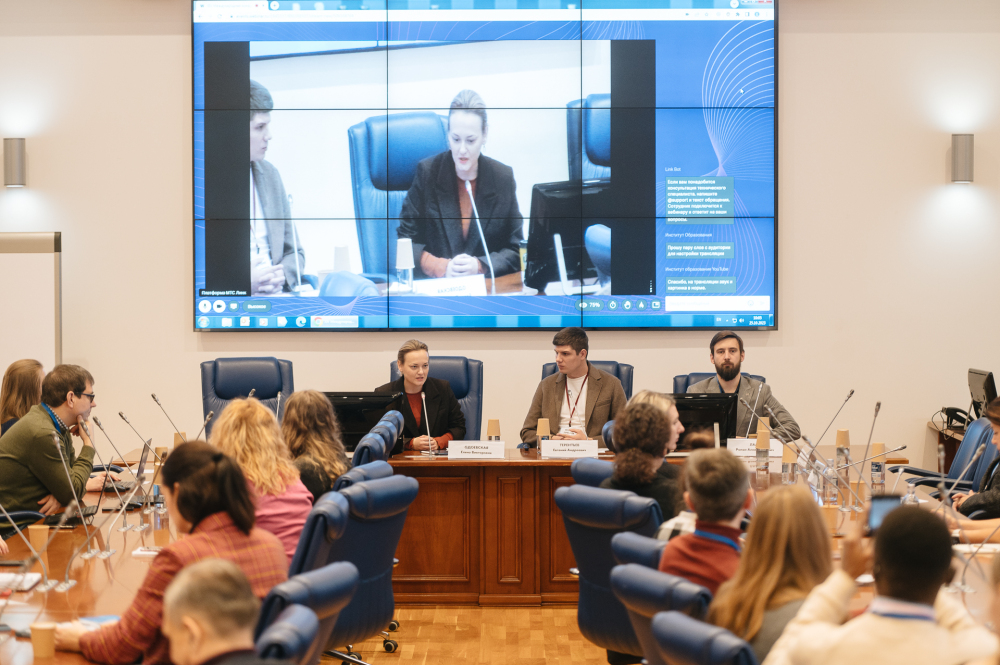


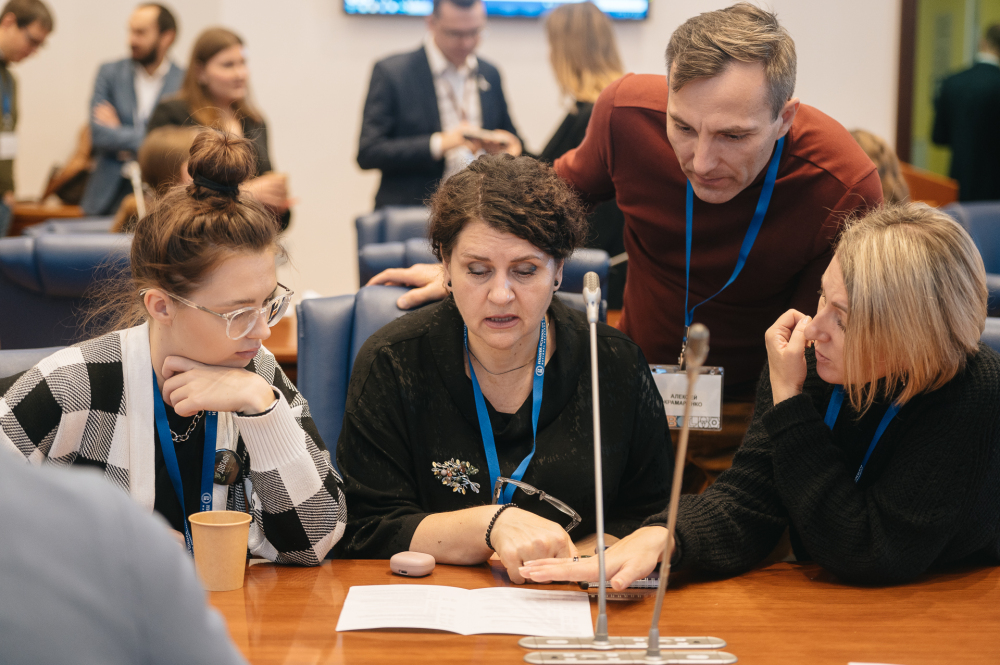


This year’s conference topic was ‘Student Experience at a Modern University: from an Enrollee to a Graduate’. Over the three days, researchers from Russia and other countries discussed the individual and institutional factors that determine students' educational experience, the impact of this experience on educational performance, and its influence on labour market success. The conference took place from October 25–27 and featured over 90 presentations.
In her opening speech, Vice Rector Elena Odoevskaya explained why student experience was chosen as the key topic of this year’s event.

Elena Odoevskaya
‘Students are the main reason why a university erects walls, creates programmes, and establishes partnerships with industries. They are the ones who will develop our country and others—among the conference participants are representatives from China, the UAE, Sri Lanka, and other countries. Therefore, it is crucial to understand the student experience within a university, their interactions with key stakeholders, and their decision-making process when selecting a university and future career path.’
Evgeniy Terentev, Director of the HSE Institute of Education, described the conference as a friends’ reunion. Fourteen years ago, when the conference was first founded, it was a small-scale affair that none would have predicted would eventually span three days and receive 200 applications.

Evgeniy Terentev
‘One of the primary objectives of the conference over the years has been to foster a research-oriented atmosphere for addressing higher education issues. While there are numerous platforms available for discussing political aspects of higher education development, there is a dearth of opportunities for discussions of evidence-based research. I propose that we take it as a rule to conduct evidence-driven conversations and substantiate our statements and findings with relevant data during the course of these three days.’
Consortia
The first roundtable, which took place on October 25, was dedicated to scientific and educational consortia formed by universities and businesses, and the evaluation of the effectiveness of their interactions.
Elena Odoevskaya moderated the event. She talked about different approaches to the concept of a consortium. For example, in the Priority 2030 programme, it is described as ‘a temporary voluntary association of universities with other organisations to coordinate activities and consolidate resources when implementing breakthrough projects that ensure the scientific and technological development of the country.’

Tatiana Zhdanova, Deputy Director at Sociocentre, told the audience that the Priority 2030 programme involves 132 universities, which have created 390 consortia with over 3,000 partners. These consortia are aimed at solving complex issues for the benefit of regions, industries, and societies, while universities get involved in these activities and attract young people to them.
Anna Stepanova, Deputy Vice President for Educational Projects at VK, spoke about cooperation with universities from the perspective of businesses: for them, the important aspects are the social part of the ESG agenda, interaction with the consumers of their products, and headhunting students. However, she believes that there is still a lack of good practices and partnerships based on mutual interest and benefit, rather than being a burden to businesses or universities.
HSE Vice Rector Irina Martusevich spoke about HSE University’s experience of employer relations and facilitating access to businesses’ young target audiences.

Irina Martusevich
HSE Vice Rector Irina Martusevich spoke about HSE University’s experience of employer relations and facilitating access to businesses’ young target audiences. ‘We give students and businesses an opportunity to shorten the initial introduction period thanks to deep integration in our projects and extracurricular activities,’ she said. Over 65% of HSE students gain working experience during their studies, which helps them make better-informed employment decisions upon graduation.
Altynai Adzhikova, Vice Rector at MTUCI, spoke about her university’s experience of industry relations, while Roman Laas, Director of the Educational Product Centre at Tomsk Polytechnic University, told the audience about ‘Big Tomsk University’, a consortium of universities and academic institutes located in Tomsk and centred around ‘on par’ interaction. The roundtable discussion finished with a discussion of the impact of consortia on student experience.
Campuses
The next conference event was a panel discussion on ‘The Possibility and Reality of University Campus Projects.’ Evgeny Terentev, who moderated the discussion, said that it follows on from the roundtable on consortia, since various institutions take part in the evolution of new campuses. In Russia, several projects are currently underway in which a single campus is created by the city for several higher education institutions. ‘The idea behind a campus is to create a comfortable environment for achieving high educational and research performance, and this requires new solutions and business models,’ he added.
Taisiya Pogodayeva, Director of BIM Campus, a company that implements the Big Ivanovo Manufacture (BIM) project as part of a concession agreement, said that the topic of campuses is much more complex, since in consortia ‘there’s no need to share properties.’ She believes that the creation of a campus gives universities a ‘chance to reinvent themselves,’ while for cities, it is a tool of spatial development.

Conference participants from various regions of Russia spoke about creating campuses in their respective cities: Sergey Kotsukon, Deputy Minister of Digital and Technological Development of Sakhalin Oblast; Alexandra Lebedeva, Deputy Prime Minister of Kamchatka Krai; Vitaly Litke, Deputy Minister of Education and Science of Chelyabinsk Oblast; Yury Marfing, Acting Rector of Pacific University in Khabarovsk.
In Sakhalin, creating a campus is not seen as at a profit-making project. ‘For us, it is an opportunity to develop the region’s infrastructure and to modernise our university,’ explained the region’s representative.
For Petropavlovsk-Kamchatsky and Ivanovo, campuses are one of the key objects in the cities’ master plans, given their central location.
Before the campus project, universities in Chelyabinsk had not interacted with each other or with regional authorities. The project is also joined by industry partners who offer venue rental, collaboration ideas, and more.

Magdalena Gaete
Magdalena Gaete, Senior Research Fellow at the Laboratory for Reputation Management in Education at HSE University-St Petersburg, spoke about global trends in campus development. There have been no cases in Europe or the USA when a decision was made to first create one campus for several universities, and only after that did the universities start cooperating. ‘A unique experiment is underway in Russia, and we will follow its progress,’ Evgeny Terentev concluded.

See also:

HSE University to Present Its Projects at the International Youth Festival
The International Youth Festival (IYF) will be held in Yekaterinburg from 11 to 17 September 2026. HSE University will take an active part in the event. The university's booth will present a space settlement mock-up, robots, and the iFORA big data analysis system. Fifty HSE students will visit festival venues, and experts will participate in the business programme.
Biologists Discover 'Molecular Fingerprint' of Preeclampsia
Researchers at HSE University employed a new method to model hypoxia in placental cells during pregnancies complicated by preeclampsia and identified molecular markers of tissue hypoxia. Since hypoxia is one of the key mechanisms underlying preeclampsia, these findings are important for a more accurate and timely diagnosis of the disease and for the development of effective treatment methods. The paper has been published in Placenta.
‘Hedgehog’ Versus ‘Relatives’: Researchers Measure How the Brain Responds to Unexpected Words During Natural Speech
Russian neurophysiologists, including researchers from HSE University, have demonstrated the feasibility of using event-related fields (ERFs) to study brain activity during natural speech perception. The researchers showed that this approach can be applied not only to individual words but also to continuous speech. Their findings indicate that words whose meanings differ significantly from the preceding context require longer processing times. The study also reveals that the brain processes function words in two stages: first, it identifies their grammatical role and then uses this information to predict the next word. The study has been published in Frontiers in Human Neuroscience.
Scientists Develop Algorithm for More Reliable Processors in Data Centres
Researchers from HSE MIEM and Samara University have developed the LRF-3D algorithm to automatically bypass idle nodes in three-dimensional networks-on-chip. Thanks to its hierarchical architecture, the algorithm outperforms existing solutions in both speed and path accuracy, improving processor reliability for use in data centres, supercomputers, and AI computing. The source code and test results are publicly available.
Researchers Rank Recommendation Algorithms Using Sports Tournament Model
Researchers from the AI and Digital Science Institute at the HSE Faculty of Computer Science have developed an approach for selecting recommendation algorithms more effectively. Their approach uses pairwise comparisons of algorithms to create a tournament table, with the overall ranking based on their performance across all datasets in the tournament. This can reduce the number of algorithms that need to be tested when developing new services, saving both time and money. The study was presented at the 32nd ACM SIGKDD Conference on Knowledge Discovery and Data Mining (KDD 2026).
Researchers Develop Method for Direct Generation of Regulatory DNA
Researchers at HSE University have developed a model for generating promoters and enhancers—DNA sequences that regulate gene activity. The model works directly with DNA nucleotides, without first transforming them into a continuous numerical representation. This solution could be useful for applications in synthetic biology and gene therapy. The study results were presented at the ICLR 2026 Workshop ‘Generative AI in Genomics (Gen^2): Barriers and Frontiers.’
Researchers at HSE University and Sber Train Neural Networks to Better Predict User Preferences
The HSE FCS AI and Digital Science Institute and Sber have introduced a new architecture for recommendation systems that combines two classes of models, enabling algorithms to better predict users’ interests and needs. A preprint of the paper has been published on arxiv.org and presented at Urban ML.
HSE Graduate School of Business and Alfa-Bank Hold Summer School for Students from China
Twenty-seven students from Chinese universities took part in the international summer school ‘Digital Product Management’ organised by the HSE Graduate School of Business and Alfa-Bank. Over the course of a week, participants explored the Russian economy and business environment, learned about current technology trends, and worked through the key stages of digital product development step by step—from researching user needs and defining a problem to developing a prototype and presenting their final project.
Physicists Discover What Happens Inside a Stable Vortex
Large vortices with characteristic spiral arms are often observed in the atmosphere and the ocean. Physicists from HSE University have explained how these structures form and why they retain their shape. The researchers found that velocities at points located along the same vortex arc remain correlated even over long distances. At the same time, this correlation weakens rapidly with increasing distance from the vortex centre. These differences help explain the formation of spiral arms and may improve models of atmospheric and oceanic currents. The findings have been published in Physical Review Fluids.
HSE University and the Government of Perm Krai Expand the Development of Creative Industries
HSE University and the Government of Perm Krai have signed a strategic partnership agreement. The document, signed by HSE University President Nikita Anisimov and Perm Krai Governor Dmitry Makhonin, defines new areas of collaboration in the creative economy, education, and human resources in Primakamye.