

HSE Scientists Develop Method to Stabilise Iodine in Solar Cells

Scientists at HSE MIEM, in collaboration with colleagues from China, have developed a method to improve the durability of perovskite solar cells by addressing iodine loss from the material. The researchers introduced quaternary ammonium molecules into the perovskite structure; these molecules form strong electrostatic pairs with iodine ions, effectively anchoring them within the crystal lattice. As a result, the solar cells retain more than 92% of their power after a thousand hours of operation at 85°C. The study has been published in Advanced Energy Materials.
Perovskites are materials with a specific crystal structure in which lead and halogen atoms (such as iodine) are combined with small organic or inorganic ions. This crystal lattice absorbs light efficiently and converts it into electricity. Over the past decade, perovskite solar cells have evolved from laboratory experiments into a major area of solar energy research. They can potentially be manufactured at a lower cost than silicon-based cells and have nearly matched them in terms of efficiency.
Iodine-based perovskites achieve efficiencies of over 26%, delivering the best performance among perovskite materials. This is because their energy structure is well suited to absorbing sunlight and capturing a large fraction of the incoming radiation. Charge carriers in these crystals have longer lifetimes, can travel greater distances, and suffer fewer losses from structural defects, which minimises undesirable charge recombination. However, iodide perovskites also have a drawback: under prolonged exposure to light and heat, their crystal lattice loses iodine, leading to erosion of the metal electrodes. As a result, the solar cell gradually deteriorates and its efficiency declines.
Previous attempts to address this issue have focused on strengthening the crystal structure or introducing molecules that bind iodine through hydrogen bonds. However, these bonds are not strong enough to retain iodine effectively during prolonged device operation. A more logical approach would be to use stronger electrostatic interactions, in which positively charged molecules firmly bind negatively charged iodine ions. Until now, however, it has been unclear how to incorporate such molecules into the perovskite crystal lattice without disrupting its structure.
In a new study, scientists from HSE MIEM, East China Normal University, Hengyang Normal University, and Ningbo University have developed a method to electrostatically retain iodine within the perovskite structure, significantly enhancing the resistance of solar cells to prolonged photothermal stress.
First, the researchers carried out theoretical calculations to identify molecules that could most effectively bind triiodide anions (I₃⁻). Quaternary ammonium compounds—molecules in which the nitrogen atom is fully surrounded by hydrocarbon groups—proved to be the most effective. This configuration enables strong confinement of triiodide ions, and subsequent experiments therefore employed tetrabutylammonium iodide (TBAI).
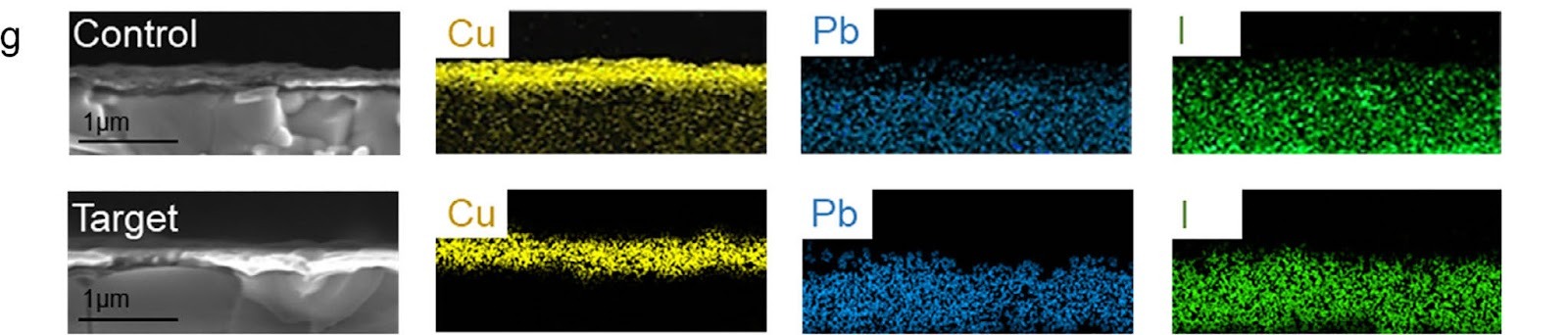
In the experimental phase, the researchers added TBAI to the solution used to form perovskite films and compared the resulting films with control samples prepared without additives. Films containing TBAI preserved their structural integrity and chemical stability under photothermal conditions, whereas the controls gradually degraded. This difference was evident from measurements of metallic lead, a marker of perovskite degradation: after 250 hours of photothermal exposure, its concentration in the modified films remained nearly unchanged, while in the control films it increased by approximately 1.5 times. In addition, the presence of TBAI almost completely suppressed the migration of iodine and copper between layers.
The researchers then tested full-scale solar cells. The addition of TBAI not only prevented degradation but also improved the properties of the material: the perovskite grains became larger and more ordered, the density of defects decreased, and the power conversion efficiency increased from 24.14% to 26.23%. For state-of-the-art perovskite devices operating close to their physical limits, such an improvement is substantial. TBAI also notably enhanced device stability: after 1,000 hours of operation at 85 °C, cells containing TBAI retained 92.5% of their initial efficiency, whereas the control device degraded to 43.8% after just 288 hours.
The authors hope that this approach to regulating electrostatic interactions in perovskites will contribute to the development of more durable solar cells.

Andrey Vasenko
'In theory, this approach could be applied to other types of halide perovskites, including materials in which iodine is combined with bromine. This would enable the development of solar panels that combine high efficiency with thermal stability,' comments Prof. Andrey Vasenko of HSE MIEM.
The study was carried out as part of the research project 'Engineering of Highly Efficient and Stable Perovskite Solar Cells.'

See also:

Personal Interest in Doctoral Thesis Topic Most Important for Confidence in Successful Defence
A researcher at HSE University analysed data on 1,539 doctoral students from 161 Russian universities to identify which features of a thesis topic are associated with academic success and engagement. The most important factor was found to be personal interest in the research topic, which was associated with almost all key aspects of doctoral programme experience—from engaging with the academic supervisor to research activity and confidence about successfully defending the thesis. The findings have been published in Higher Education.
Researchers Develop Methodology to Assess the Quality of Legal Representation in Criminal Proceedings
Having a good defence attorney in criminal proceedings can largely determine whether a defendant retains their freedom, health and good name. Researchers at HSE University propose a method for predicting an attorney’s performance based on the outcomes of their previous cases. The methodology takes into account the severity of the charges, the complexity of the cases, and the most likely outcome, drawing on judicial statistics.
When Pictures Hinder Understanding: Illustrations May Impede Learning of Abstract Ideas
Illustrations can help remember specific actions but do not always make abstract ideas easier to learn. Researchers from HSE University and Humboldt University compared how people learn from texts with different levels of abstractness. They found that participants remembered illustrations better and performed better on related tasks after reading a multimedia text about yoga asanas than after reading an abstract text about the Nash equilibrium. The findings could help improve the selection of illustrations for educational and informational materials. The study has been published in Learning and Instruction.
HSE Researchers Present Study on Neural Network Robustness in Video Analysis at ChinaMM 2026
Researchers from HSE University presented a study at the international ChinaMM 2026 conference on how video transmission distortions affect the performance of neural networks. The authors proposed a new approach to testing the robustness of such models under conditions that closely resemble the real-world use of video services.
HSE University to Develop Predictive Analytics System for Icebreaker Motors
Industrial automation is one of the key applications of artificial intelligence. A predictive analytics system for large electric motors is among the solutions being developed for the industry as part of HSE University’s Strategic Technological Project ‘Multi-Agent Platform of AI Solutions for Industry-Specific Tasks.’ What is predictive analytics, how can it improve the operation of electric motors, and what specialists joined forces to develop this technology? Anton Zarubin, Dean of the School of Computer Science, Physics, and Technology at HSE University–St Petersburg and the project development coordinator, explains in this interview with the HSE News Service.
Scientific Expedition to Hainan: HSE Scientists Organise Conference on Statistical AI in China
The Statistical AI Conference was held in Sanya, Hainan Island, China, from 24 to 28 August 2026. The international event brought together leading experts in statistics, machine learning, and applied AI. Alexey Naumov, Director of the AI and Digital Science Institute at the HSE Faculty of Computer Science, and Sergey Samsonov, Head of the International Laboratory of Stochastic Algorithms and High-Dimensional Inference, were among the conference organisers.
How to Assess Students’ Knowledge in the Age of AI
A researcher at HSE University has proposed a flowchart to help lecturers decide how to assess students who use artificial intelligence. It shows where the use of AI should be restricted and where it can be incorporated into the learning process. The article has been published in IT Professional.
5th Fall into ML Conference to Bring Together Leading AI Researchers
The AI and Digital Science Institute at the HSE Faculty of Computer Science invites researchers, developers and everyone shaping the future of technology to the fifth, anniversary edition of the Fall into Machine Learning conference (Fall into ML 2026). The event will take place on October 23–24, 2026, at the HSE Cultural Centre in Moscow and will become the key meeting point for Russia’s AI community.
HSE University Expands Cooperation with Malaysia in Technology Foresight
HSE University researchers will take part in a study of the future of engineering education in Malaysia, while the Malaysian Industry-Government Group for High Technology (MIGHT) will use the iFORA big-data analysis system to validate the findings of its foresight research. These are the outcomes of a visit by HSE representatives to Kuala Lumpur.
Scientists Train Neural Network to Generate Process Plans from 3D Models
Researchers at the HSE FCS AI and Digital Science Institute have developed CAD2TechSpec, a framework that converts 3D models of mechanical parts into machining process plans—step-by-step instructions for machine tools. The solution aims to reduce the time required for the design and preparation of technical process documentation in mechanical engineering, aircraft manufacturing, and other high-tech industries. The study findings have been published in PeerJ Computer Science.