

HSE Researchers Create Genome-Wide Map of Quadruplexes

An international team, including researchers from HSE University, has created the first comprehensive map of quadruplexes—unstable DNA structures involved in gene regulation. For the first time, scientists have shown that these structures function in pairs: one is located in a DNA region that initiates gene transcription, while the other lies in a nearby region that enhances this process. In healthy tissues, quadruplexes regulate tissue-specific genes, whereas in cancerous tissues they influence genes responsible for cell growth and division. These findings may contribute to the development of new anticancer drugs that target quadruplexes. The study has been published in Nucleic Acids Research.
The word 'DNA' usually brings to mind a double helix, but this molecule can adopt other forms as well. In some regions, the DNA strand can unwind, bend, and form a small knot. If such a fragment is rich in guanine (denoted by the letter G in the DNA sequence), it can fold into a quadruplex—a three-dimensional structure in which several layers of guanine are stacked on top of one another. For proteins that regulate gene activity, these structures serve as prominent landmarks, helping them locate the correct regions of DNA.
Quadruplexes are short-lived structures: they form rapidly, perform their function, and then disappear, meaning that experiments can capture only a fraction of them. Moreover, different experimental methods detect different types of quadruplexes. As a result, it has not been possible to create a genome-wide map that includes all DNA regions where quadruplexes can form.
To address this problem, the team of HSE researchers further trained the genomic language model DNABERT on quadruplex data and used its predictions to reconstruct where these structures arise across the genome.

Maria Poptsova
'In our study, we trained DNABERT on EndoQuad, the world’s largest database of experimentally validated quadruplexes, resulting in the GQ-DNABERT model. This model evaluates DNA sequences to predict where a quadruplex is likely to form,' comments Maria Poptsova, Director of the Centre for Biomedical Research and Technology at the HSE Faculty of Computer Science.
Unlike simple algorithms that search only for sequences capable of forming a quadruplex, GQ-DNABERT also considers the surrounding DNA context, which determines whether a region actually folds into a quadruplex. As a result, the model was able to predict about 360,000 quadruplexes—far more than have been identified by individual experimental methods.
The model confirmed the well-known fact that quadruplexes frequently occur in promoters—DNA regions upstream of genes where transcription is initiated. Unexpectedly, many quadruplexes were also found in nearby enhancers, genomic elements that boost gene transcription and influence how much protein is produced. The researchers discovered that quadruplexes often form simultaneously in both the promoter and the enhancer, creating pairs that jointly regulate gene activity.
To investigate the role of these pairs in cells, the researchers used single-cell sequencing data from experiments. In such datasets, the DNA regions that are statistically associated with the activity of specific genes are pre-identified. By overlaying the GQ-DNABERT map for six tissue types onto these data, the scientists found that promoter–enhancer pairs are more often associated with genes responsible for tissue-specific functions: in the brain, for neuronal development and function; in the blood, for immune cell activity; and in the intestine, for epithelial functions. The researchers then examined these pairs in tumour tissues and compared them with those in healthy tissues. While the number of promoter–enhancer pairs containing quadruplexes was similar, the functions of the associated genes differed dramatically.
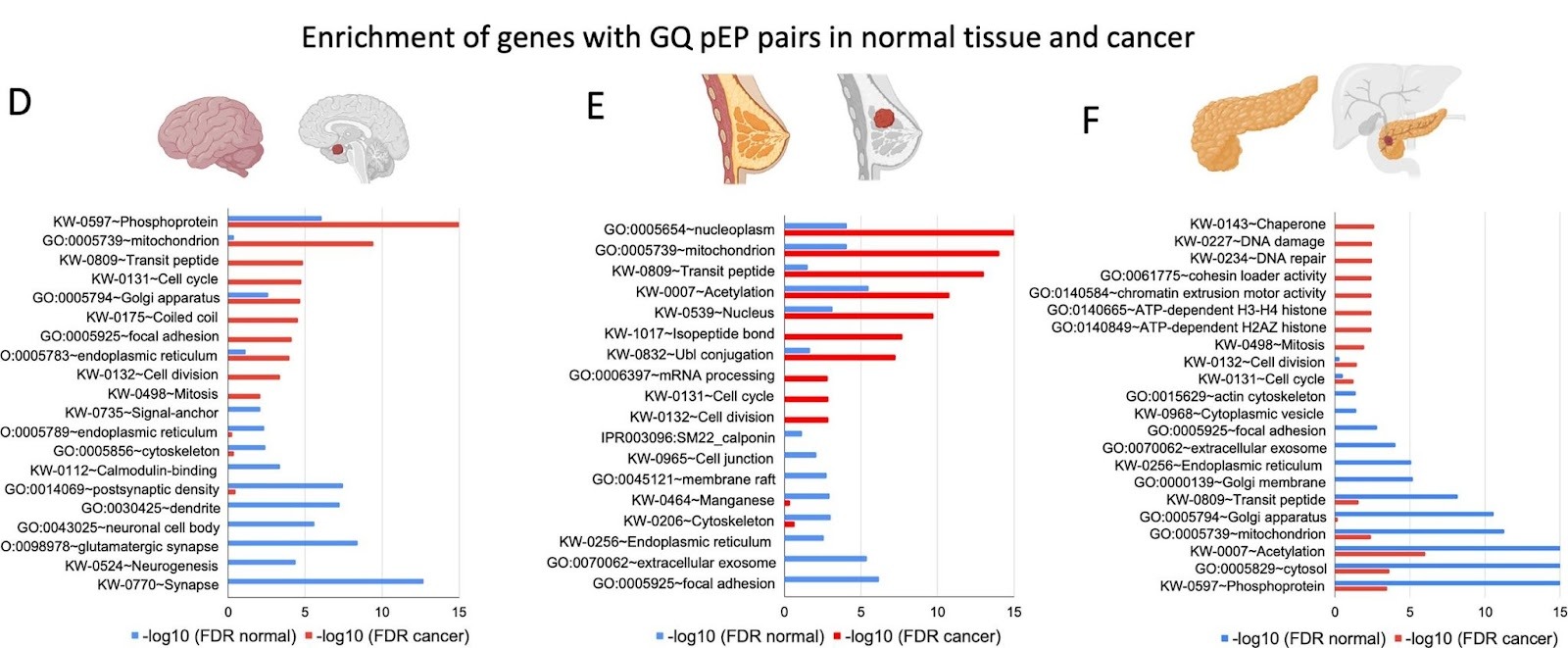
'In normal cells, these pairs are associated with tissue-specific programmes, whereas in cancer cells they are linked to universal processes of cell division and growth that drive tumour proliferation regardless of the tissue of origin,' explains Poptsova. 'In other words, in healthy cells, these pairs support tissue specialisation, while in cancer they become part of general programmes for rapid cell division.'
The resulting map of quadruplexes provides a clearer understanding of how these structures regulate gene activity in both normal and tumour cells. In the future, this information could be used to develop new anticancer drugs that selectively target quadruplexes.
The study was supported by a grant from the HSE AI Research Centre.

See also:

Personal Interest in Doctoral Thesis Topic Most Important for Confidence in Successful Defence
A researcher at HSE University analysed data on 1,539 doctoral students from 161 Russian universities to identify which features of a thesis topic are associated with academic success and engagement. The most important factor was found to be personal interest in the research topic, which was associated with almost all key aspects of doctoral programme experience—from engaging with the academic supervisor to research activity and confidence about successfully defending the thesis. The findings have been published in Higher Education.
Researchers Develop Methodology to Assess the Quality of Legal Representation in Criminal Proceedings
Having a good defence attorney in criminal proceedings can largely determine whether a defendant retains their freedom, health and good name. Researchers at HSE University propose a method for predicting an attorney’s performance based on the outcomes of their previous cases. The methodology takes into account the severity of the charges, the complexity of the cases, and the most likely outcome, drawing on judicial statistics.
When Pictures Hinder Understanding: Illustrations May Impede Learning of Abstract Ideas
Illustrations can help remember specific actions but do not always make abstract ideas easier to learn. Researchers from HSE University and Humboldt University compared how people learn from texts with different levels of abstractness. They found that participants remembered illustrations better and performed better on related tasks after reading a multimedia text about yoga asanas than after reading an abstract text about the Nash equilibrium. The findings could help improve the selection of illustrations for educational and informational materials. The study has been published in Learning and Instruction.
HSE Researchers Present Study on Neural Network Robustness in Video Analysis at ChinaMM 2026
Researchers from HSE University presented a study at the international ChinaMM 2026 conference on how video transmission distortions affect the performance of neural networks. The authors proposed a new approach to testing the robustness of such models under conditions that closely resemble the real-world use of video services.
HSE University to Develop Predictive Analytics System for Icebreaker Motors
Industrial automation is one of the key applications of artificial intelligence. A predictive analytics system for large electric motors is among the solutions being developed for the industry as part of HSE University’s Strategic Technological Project ‘Multi-Agent Platform of AI Solutions for Industry-Specific Tasks.’ What is predictive analytics, how can it improve the operation of electric motors, and what specialists joined forces to develop this technology? Anton Zarubin, Dean of the School of Computer Science, Physics, and Technology at HSE University–St Petersburg and the project development coordinator, explains in this interview with the HSE News Service.
Scientific Expedition to Hainan: HSE Scientists Organise Conference on Statistical AI in China
The Statistical AI Conference was held in Sanya, Hainan Island, China, from 24 to 28 August 2026. The international event brought together leading experts in statistics, machine learning, and applied AI. Alexey Naumov, Director of the AI and Digital Science Institute at the HSE Faculty of Computer Science, and Sergey Samsonov, Head of the International Laboratory of Stochastic Algorithms and High-Dimensional Inference, were among the conference organisers.
How to Assess Students’ Knowledge in the Age of AI
A researcher at HSE University has proposed a flowchart to help lecturers decide how to assess students who use artificial intelligence. It shows where the use of AI should be restricted and where it can be incorporated into the learning process. The article has been published in IT Professional.
5th Fall into ML Conference to Bring Together Leading AI Researchers
The AI and Digital Science Institute at the HSE Faculty of Computer Science invites researchers, developers and everyone shaping the future of technology to the fifth, anniversary edition of the Fall into Machine Learning conference (Fall into ML 2026). The event will take place on October 23–24, 2026, at the HSE Cultural Centre in Moscow and will become the key meeting point for Russia’s AI community.
HSE University Expands Cooperation with Malaysia in Technology Foresight
HSE University researchers will take part in a study of the future of engineering education in Malaysia, while the Malaysian Industry-Government Group for High Technology (MIGHT) will use the iFORA big-data analysis system to validate the findings of its foresight research. These are the outcomes of a visit by HSE representatives to Kuala Lumpur.
Scientists Train Neural Network to Generate Process Plans from 3D Models
Researchers at the HSE FCS AI and Digital Science Institute have developed CAD2TechSpec, a framework that converts 3D models of mechanical parts into machining process plans—step-by-step instructions for machine tools. The solution aims to reduce the time required for the design and preparation of technical process documentation in mechanical engineering, aircraft manufacturing, and other high-tech industries. The study findings have been published in PeerJ Computer Science.