

Beauty in Details: HSE University and AIRI Scientists Develop a Method for High-Quality Image Editing
Researchers from the HSE AI Research Centre, AIRI, and the University of Bremen have developed a new image editing method based on deep learning—StyleFeatureEditor. This tool allows for precise reproduction of even the smallest details in an image while preserving them during the editing process. With its help, users can easily change hair colour or facial expressions without sacrificing image quality. The results of this three-party collaboration were published at the highly-cited computer vision conference CVPR 2024.
Artificial intelligence is already able to generate and edit images using generative adversarial networks (GANs). The architecture consists of two independent networks: a generator that creates images and a discriminator that distinguishes between real and generated samples. These networks compete with each other, and a new stage in their development is the StyleGAN model. This model can generate images and modify specific parts based on user requests, but it has not been able to work with real photos or images before.
Researchers from the HSE AI Research Centre, the Artificial Intelligence Research Institute (AIRI), and the University of Bremen have proposed a method to quickly and efficiently edit real images. This StyleFeatureEditor approach consists of two modules: the first inverts (reconstructs) the original image, and the second edits this reconstruction. The results of these two steps are passed to StyleGAN, which generates the edited image based on the internal representations. The developers addressed some challenges that had been encountered in previous research. With a small set of representations, the network could edit the image well, but it lost some details from the original. However, with a larger set, all the details were preserved, but the network had difficulty transforming them correctly according to the task.
To solve this, the researchers proposed a new solution: the first module finds both large and small representations, while the second learns how to edit the larger ones using the smaller ones as reference.
However, to train these modules to accurately edit the representations, the neural network requires both real images and their edited versions.

‘We needed examples, such as the same face with different expressions, hairstyles, and details. Unfortunately, such image pairs do not exist at the moment. So, we came up with a trick: using a method that works with small representations, we created a reconstruction of a real image and an example of editing this reconstruction. Although the examples were relatively simple and without details, the model clearly understood how to make the edits,’ explains Denis Bobkov, one of the authors of the article, a research intern at the Centre of Deep Learning and Bayesian Methods of the AI and Digital Science Institute (part of the HSE Faculty of Computer Science), and a Junior Research Fellow at AIRI’s Fusion Brain Lab.
However, training only on generated (simple) examples leads to a loss of detail when working with real (complex) images. To prevent this, the researchers added real images to the training dataset, and the neural network learnt to reconstruct them in detail.
Thus, by showing the model how to edit both simple and complex images, the scientists created conditions under which the network could edit complex images more effectively. In particular, the developed approach handles adding new elements of style while preserving the details of the original image better than other existing methods.
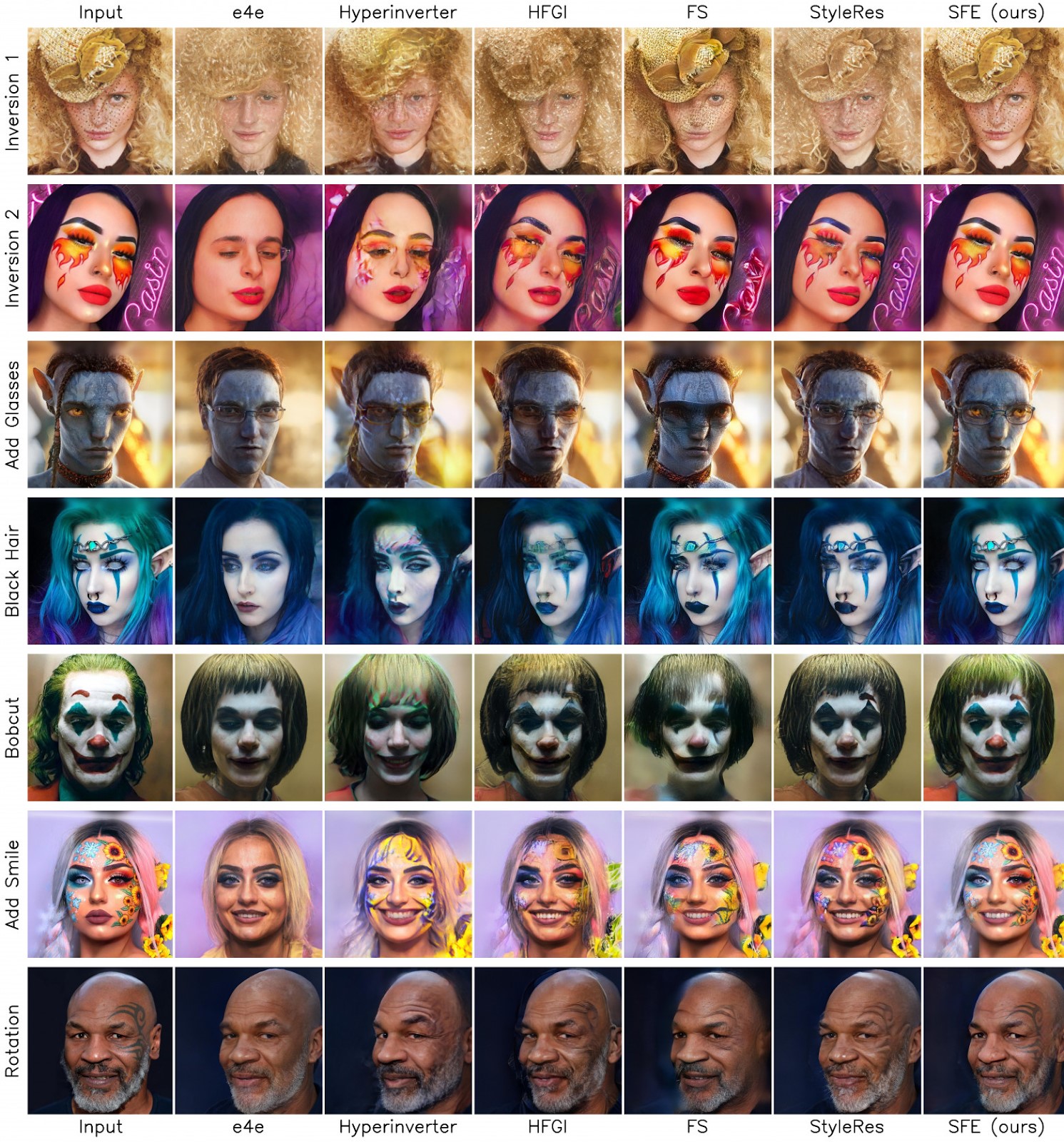
In the case of simple reconstruction (first row), StyleFeatureEditor accurately reproduced a hat, while most other methods almost completely lost it. The developed method showed the best results with additional accessories (third row): most methods could add glasses, but only the StyleFeatureEditor retained the original eye colour.

‘Thanks to this training technique on generated data, we have obtained a model with high editing quality and a fast processing speed due to the use of relatively lightweight neural networks. The StyleFeatureEditor framework requires only 0.07 seconds to edit a single image,’ says Aibek Alanov, Head of the Centre of Deep Learning and Bayesian Methods of the AI and Digital Science Institute (part of the HSE Faculty of Computer Science), and leader of the research group ‘Controlled Generative AI’ at AIRI's Fusion Brain Lab.
The research was funded by a grant from the Analytical Centre under the Government of the Russian Federation for AI research centres.
The research results will be presented at the Fall into ML 2024 conference on artificial intelligence and machine learning, which will take place at HSE University on October 25–26, 2024. Leading AI scientists will discuss the best papers published at top-tier (A*) flagship AI conferences in 2024. A demo of the developed method can be tried out on HuggingFace, and the source code is available on GitHub.
See also:

Banking Crises Drive Biodiversity Loss
Economists from HSE University, MGIMO University, and Bocconi University have found that financial crises have a significant negative impact on biodiversity and the environment. This relationship appears to be bi-directional: as global biodiversity declines, the likelihood of new crises increases. The study examines the status of populations encompassing thousands of species worldwide over the past 50 years. The article has been published in Economics Letters, an international journal.
Scientists Discover That the Brain Responds to Others’ Actions as if They Were Its Own
When we watch someone move their finger, our brain doesn’t remain passive. Research conducted by scientists from HSE University and Lausanne University Hospital shows that observing movement activates the motor cortex as if we were performing the action ourselves—while simultaneously ‘silencing’ unnecessary muscles. The findings were published in Scientific Reports.
Russian Scientists Investigate Age-Related Differences in Brain Damage Volume Following Childhood Stroke
A team of Russian scientists and clinicians, including Sofya Kulikova from HSE University in Perm, compared the extent and characteristics of brain damage in children who experienced a stroke either within the first four weeks of life or before the age of two. The researchers found that the younger the child, the more extensive the brain damage—particularly in the frontal and parietal lobes, which are responsible for movement, language, and thinking. The study, published in Neuroscience and Behavioral Physiology, provides insights into how age can influence the nature and extent of brain lesions and lays the groundwork for developing personalised rehabilitation programmes for children who experience a stroke early in life.
Scientists Test Asymmetry Between Matter and Antimatter
An international team, including scientists from HSE University, has collected and analysed data from dozens of experiments on charm mixing—the process in which an unstable charm meson oscillates between its particle and antiparticle states. These oscillations were observed only four times per thousand decays, fully consistent with the predictions of the Standard Model. This indicates that no signs of new physics have yet been detected in these processes, and if unknown particles do exist, they are likely too heavy to be observed with current equipment. The paper has been published in Physical Review D.
HSE Scientists Reveal What Drives Public Trust in Science
Researchers at HSE ISSEK have analysed the level of trust in scientific knowledge in Russian society and the factors shaping attitudes and perceptions. It was found that trust in science depends more on everyday experience, social expectations, and the perceived promises of science than on objective knowledge. The article has been published in Universe of Russia.
Scientists Uncover Why Consumers Are Reluctant to Pay for Sugar-Free Products
Researchers at the HSE Institute for Cognitive Neuroscience have investigated how 'sugar-free' labelling affects consumers’ willingness to pay for such products. It was found that the label has little impact on the products’ appeal due to a trade-off between sweetness and healthiness: on the one hand, the label can deter consumers by implying an inferior taste, while on the other, it signals potential health benefits. The study findings have been published in Frontiers in Nutrition.
HSE Psycholinguists Launch Digital Tool to Spot Dyslexia in Children
Specialists from HSE University's Centre for Language and Brain have introduced LexiMetr, a new digital tool for diagnosing dyslexia in primary school students. This is the first standardised application in Russia that enables fast and reliable assessment of children’s reading skills to identify dyslexia or the risk of developing it. The application is available on the RuStore platform and runs on Android tablets.
Physicists Propose New Mechanism to Enhance Superconductivity with 'Quantum Glue'
A team of researchers, including scientists from HSE MIEM, has demonstrated that defects in a material can enhance, rather than hinder, superconductivity. This occurs through interaction between defective and cleaner regions, which creates a 'quantum glue'—a uniform component that binds distinct superconducting regions into a single network. Calculations confirm that this mechanism could aid in developing superconductors that operate at higher temperatures. The study has been published in Communications Physics.
Neural Network Trained to Predict Crises in Russian Stock Market
Economists from HSE University have developed a neural network model that can predict the onset of a short-term stock market crisis with over 83% accuracy, one day in advance. The model performs well even on complex, imbalanced data and incorporates not only economic indicators but also investor sentiment. The paper by Tamara Teplova, Maksim Fayzulin, and Aleksei Kurkin from the Centre for Financial Research and Data Analytics at the HSE Faculty of Economic Sciences has been published in Socio-Economic Planning Sciences.
Larger Groups of Students Use AI More Effectively in Learning
Researchers at the Institute of Education and the Faculty of Economic Sciences at HSE University have studied what factors determine the success of student group projects when they are completed with the help of artificial intelligence (AI). Their findings suggest that, in addition to the knowledge level of the team members, the size of the group also plays a significant role—the larger it is, the more efficient the process becomes. The study was published in Innovations in Education and Teaching International.