

Irrationality in the Acts of Humans, as Well as Bees
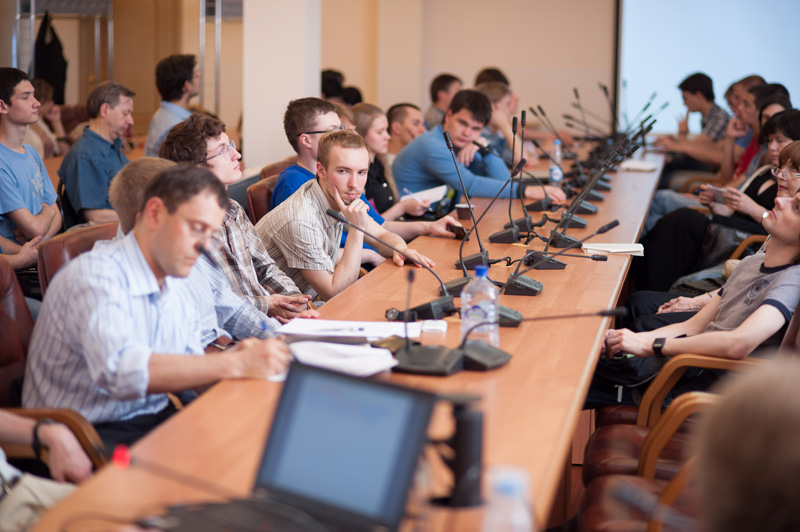
On May 21st 2011, Robert Aumann, Nobel laureate in economics and Professor at the Hebrew University of Jerusalem, spoke at the HSE on ‘Rule Rationality vs. Act Rationality’. The lecture was organized by the HSE together with the Embassy of Israel in Russia.

Yisrael Robert John Aumann is a renowned Israeli and American mathematician, one of the leading researchers in game and equilibrium theory who has been awarded by several prizes for his work in economics. Professor Aumann headed the Game Theory Society for a long time and specializes in ‘repeated games’ and analysis of the development of conflict over time. It was ‘for having enhanced our understanding of conflict and cooperation through game-theory analysis’ that he was awarded the Nobel Prize in economics in 2005.
In his lecture entitled ‘Rule Rationality vs. Act Rationality’, Robert Aumann spoke about the problem of rationality in the scheme of behavior and everyday activities of living creatures, particularly, humans. ‘An economic system, be it on a world, country or a household level, - is a very complex system, and for centuries, economic analysis was based on the idea that the people act rationally’, professor Aumann explained, ‘During the last ten or fifteen years this approach has been questioned by representatives of such field as behavioural economics, and according to them, put simply, human behavior is systematically irrational. I would like to compare these two approaches’.
What does ‘Act Rationality’ mean? People always do what is best for them in each specific situation, considering the potential profits and losses. In the case of ‘Rule Rationality’, people do not optimize each of their actions separately, but instead they rely on rules and behavior patterns developed for general cases – inherited from previous experience or even evolution.
To illustrate this contradiction, professor Aumann spoke about an experiment with bees which was conducted by Andreas Bertch in 1985. A colony of bees was released into a specially created space with artificial flowers: blue and yellow. A special mechanism delivered nectar to the blue flowers, and through trial and error the bees understood that they should fly to the blue flowers. After that Bertch changed the conditions, and only the yellow flowers started giving nectar. Nevertheless, the bees, acting according to their accumulated experience (Rule Rationality), continued to look for nectar in the blue flowers and eventually died of hunger. This means that their behavior, which was rational, based on experience and rules, turned out to be irrational in the new context.
 One might say that we should not expect bees to be rational. But professor Aumann believes that rationality is a feature of any evolutionary mechanism. Only the strongest and the best adapted should survive, and rational behavior improves the chances of survival.
Another experiment, conducted by a team of German researchers in the early 1980s, illustrates human behavior that might be considered ‘strange’, from an economic point of view. Two people, who do not know each other and have never met, are placed in different rooms. One of them gets one hundred deutschmarks and, according to the terms of the experiment, should offer a certain share to the second participant. If the offer is accepted, both of them get the agreed shares. If the second participant refuses the offer, both get nothing. It would seem rational and logical for second participant to accept any offer. But during repeated experiments with different people it became clear that the second participant would only accept the offer if it was relatively ‘fair’ and ‘not humiliating’. Offers with the proportion 65/35 or more generous ones were accepted in most cases, while offers with proportion 80/20, let alone 90/10, usually were declined since they were perceived as insulting.
Though the experiment participants were incognito, they acted as if they were afraid that other people would find out about their ‘compliance’. In a usual, open situation, if they would accept a 10 or 20% share from the offer, they would gain the reputation of people who are easy to trade with, who could be ‘bought for cheap’. In this case, their concern about their reputation would be strategically reasonable and rational. If they refused such a deal, they might hope that next time they would be given a better offer. But in the context of this specific experiment, refusing the small share was irrational: it could not affect their reputation.
But there is no unsolvable contradiction here. While decision-making is based on following traditional rules or the optimization of a specific action, we act according to utilitarian, egoistical reasons. And rationality, according to professor Aumann, is an expression of evolutionary powers, which work ‘according to rules and not by exceptions or artificial situations’.
Oleg Seregin, HSE News Service
Photos by Nikita Benzoruk

See also:

HSE Students Win Six Gold Medals at International Mathematics Competition for University Students
Students from the HSE Faculty of Computer Science (FCS) and Faculty of Mathematics have won six gold medals at the International Mathematics Competition for University Students (IMC). HSE students also received silver and bronze medals. One of the world’s most prestigious international university mathematics competitions, IMC 2026 was held in July–August this year in Blagoevgrad, Bulgaria.
‘AI Enables Researchers to Tackle More Complex and Important Problems’
In late July 2026, Dmitry Rybin, a graduate of the HSE Faculty of Mathematics who is now working in China, used ChatGPT to disprove a longstanding mathematical hypothesis. In an interview with the HSE News Service, he discussed AI's ability to make discoveries in mathematics, reflected on his time at HSE University, and spoke about his doctoral research at the Chinese University of Hong Kong.
‘The Conference Strengthened Our Sense of Belonging to the International Mathematics Community’
From July 13 to 17, 2026, the HSE Faculty of Mathematics hosted the international conference ‘Moduli, Dynamics, and Integrability,’ bringing together leading mathematicians from Russia, the United States, China, the United Kingdom, and other countries.
Fair Division: How Mathematics Helps to Divide the Indivisible
How can items be allocated among participants so that no one feels short-changed? Alexander Karpov, Assistant Professor at the Faculty of Economic Sciences, and his Singaporean colleague, Prof. Warut Suksompong, set out to find a mathematical answer to this question. In this interview, they discuss how a model of rational preferences is constructed, why one cannot rely on a simple sum of values, and where an algorithm that asks a minimal number of questions can be useful.
HSE Students Win Gold Medals at International Mathematics Olympiad in Turkmenistan
The VI Open Mathematical Olympiad for University Students (OMOUS-2026) was held in Ashgabat, bringing together teams from Russia, Germany, Greece, Hungary, the Netherlands, Turkmenistan, Tajikistan, Uzbekistan, Iran, and the UAE. Around 600 students took part in the competition.
Experiments in Economics
Why simulate an auction? How do experiments in economics differ from those in psychology? Assistant Professor Alexander Usvitskiy, Head of the Laboratory for Experimental Economics and Finance, discusses the laboratory's activities and research approaches.
'Sometimes, Finding Ways to Solve Problems Feels Like Trying to Cross Mountains without a Map'
Yulia Zaitseva became interested in mathematics in third grade, when her parents enrolled her in a math club, and she now holds a PhD. In this interview with the HSE Young Scientists project, she explains what an algebraic variety is, discusses operations beyond addition and multiplication, and shares her love for Kolomenskoye Park.
Human Intuition Proves Stronger than Algorithms: Game Theory Tournament Held at HSE University in Perm
Researchers from the International Laboratory of Intangible-driven Economy (Perm) and the HSE Laboratory of Sports Studies, together with mathematician and science populariser Alexey Savvateev, organised a game theory tournament entitled ‘The Election Race.’ Participants competed both against one another and against artificial intelligence. For now, humans have managed to gain the upper hand and propose more effective strategies.
Mathematician from HSE University–Nizhny Novgorod Solves Equation Considered Unsolvable in Quadratures Since 19th Century
Mathematician Ivan Remizov from HSE University–Nizhny Novgorod and the Institute for Information Transmission Problems of the Russian Academy of Sciences has made a conceptual breakthrough in the theory of differential equations. He has derived a universal formula for solving problems that had been considered unsolvable in quadratures for more than 190 years. This result fundamentally reshapes one of the oldest areas of mathematics and has potential to have important implications for fundamental physics and economics. The paper has been published in Vladikavkaz Mathematical Journal.
‘Our Subject Is Absolute Truth in the Literal Sense’
What path does one have to follow to become a theoretical mathematician? Is there such a thing as a ‘mathematical personality’? And is it really true that all mathematicians are a bit eccentric? Valery Gritsenko, Professor at the Faculty of Mathematics and Head of the International Laboratory for Mirror Symmetry and Automorphic Forms, talks about 13-year-long referee reports and good films about mathematics.