

Baltic Practice 2012
The HSE’s Baltic Practice Summer School has just finished in Klaipeda and Kaunas. Once again, the school was run in conjunction with Vytautas Magnus University (Lithuania).

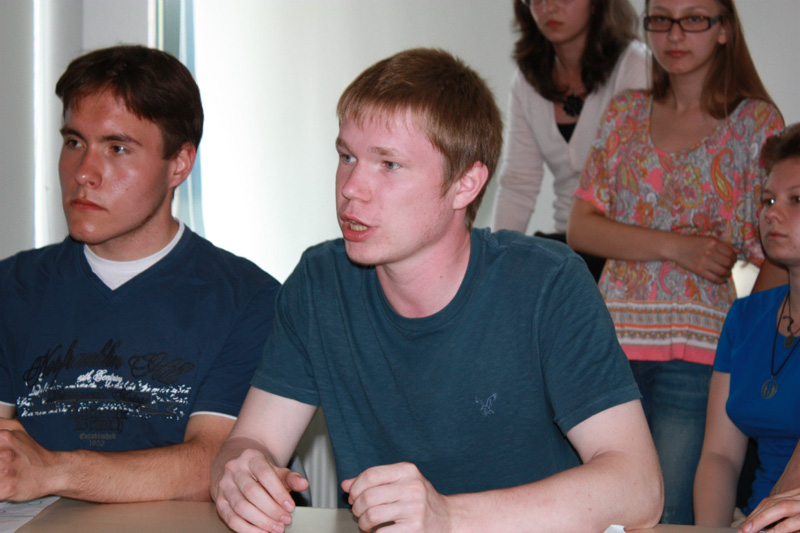


This year, the participants of the Baltic Practice included students from the HSE, Lomonosov Moscow State University (MSU, Russia), National University of Science and Technology (MISIS, Russia), Southern Federal University (Russia), University of Bologna (Italy) andVytautas Magnus University. The teaching staff of the Summer School was also quite varied, including the Ombudsman of Rotterdam (the Netherlands). Members of the Baltic Practice jury included Mayors of Kaunas and Klaipeda, and the School’s academic supervisors were professors from Germany, Russia, Lithuania and Italy.
The main topic of the Summer School was ‘European Communities: Local and Global Contexts’. The key areas of group work were online communities, analytical communities, the anti-war movement and soft law. A collection of both student and lecturers’ papers from the event will be published.
Day One
The first day of the school was dedicated to the global human rights community, soft law and human rights. Key speakers included Yury Fogelson, Deputy Head of the HSE Department of Public Policy, Anita Soboleva, Associate Professor at the same department, Svetlana Chekhovskaya, Associate Professor at the HSE Department of Entrepreneurial Law, Aldo Berlinguer,Professor at the University of Cagliari, and Linas Venslauskas, Professor at Vytautas Magnus University.
The official opening of the Baltic Practice International Summer School also took place on this day. The speakers at the plenary session were Anita Soboleva (HSE), Simon Matissen (Rotterdam) and Vladimir Slivyak (EkoZashchita), and they presented their papers on various aspects of human rights protection.
Anita Soboleva spoke about the global human rights networks and Simon Mattisen told the students about the details of an ombudsman’s work, based on his 20 years of work in this position. Vladimir Slivyak’s presentation was dedicated to how ecology organizations organize campaigns on such critical contemporary problems as radioactive waste storage, green energy and others.
Given the interest aroused by the presentations and the number of questions the students asked, it’s clear that the participants were prepared for the special school format, which was an academic conference aimed not at passive reception of information, but at an independent discussion of political problems.
After the plenary session the students continued their research in work groups, which allowed them not only to express their own ideas on specific issues, but to have these ideas evaluated by academic supervisors and fellow students.
In addition to postgraduate students, for the first time among the participants of the Summer School were younger specialists who had just graduated.
The workload at the Summer School should also be mentioned. The classes finished at 10 p.m. for students, but the teachers attended sessions of the ‘Professor Club’ after that, chaired by Yury Fogelson. There, they allotted their marks for the work during the day, discussed academic plans and listened to reports.
Day Two
The second day of the Summer School was dedicated to ‘analytical and online communities and the response to global challenges’. But the key event of the day was the meeting with Andrius Kupčinskas, Mayor of Kaunas, where the students learnt about real global challenges to local communities, specifically the city of Kaunas, which is suffering from a severe migration away from the city by young people, due to border transparency. Other Kaunas officials also participated in the discussion, such as the Assistant to the Mayor with responsibility for working with communities. During the preparation for the visit each work group formed a list of questions based on their research agenda.
Day Three
The third School day was dedicated to ‘global civil communities, civil control and civil protest’. The day started with a plenary session with representatives from Vytautas Magnus University. They spoke about communities in Lithuania, including ethnic minorities and the problems of the Russian-speaking population in Lithuania.
Plenary sessions and group work transferred from university classes to a bus. To save time, the 2.5 hours of the trip from Kaunas to Klaipeda were used as a class. Particularly, the students took the EUBAT experimental test provided by Professor Peter Isakson, to check their knowledge of the history and culture of the European Union.
Professor Isakson spoke at the first session in Klaipeda and gave a detailed review of the test which had ben taken by the students on their way from Kaunas to Klaipeda. Its uniqueness is that it reveals not the students knowledge of facts, but the respondent’s attitude to them. During the lecture the students had the opportunity to learn about the many important details and pitfalls which a community researcher may stumble upon.
The key events of the whole school were a series of academic debates entitled ‘European communities: one or many’. The students were divided into two groups: the first advocated the ‘ONE’ position, and the other- ‘MANY’ – this group’s academic supervisor was Gerhard Ermischer.
The preparation for the debates took almost 24 hours. Both groups held detailed consultations with the lecturers at the Baltic Practice, studied hundreds of sources, searching not only for arguments for their view, but for the counterarguments from their opponents. The debates were moderated by Nina Belyaeva, Head of the HSE Department of Public Policy and Academic Supervisor of the Summer School. The presentations were evaluated both by lecturers and the participants themselves. The jury also awarded marks. After the dust had settled, the group advocating the position of European communities’ multiplicity won by a small margin.
After the debates, the lecturers gave the final marks and summarized week’s activities . At the certificate ceremony, Nina Belyaeva reminded the audience about the three academic credits received by participants for their work at the Baltic Practice. The Summer School head specifically mentioned the leaders of the Practice’s study process: Elza Fogel, Kamil Galeev, Ekaterina Vdovinets and Georgy Tyulyaev. She also mentioned that Angelina Egorova and Dmitry Ayusheev managed to overcome the difficulties of communication in English and have successfully taken part..
The informative part of the Summer School has not finished along with its academic part. The Baltic Practice schedule intentionally included one free day. This was the day when Klaipeda celebrated its annual ‘Sea Day’. The participants had an opportunity to see places of interest, including, of course, the Curonian Spit, to attend various festival events, and to swim in the sea. So, the twelfth Baltic Practice Summer School, in our (participant students) opinion, was quite successful. Which, obviously, would be impossible without tall the effort put in by the organizers: Svetlana Lipina, Anita Soboleva, Oxana Chernenko, Svetlana Chekhovskaya, Vladimir Slivyak, Vadim Karastelev, Simon Mattisen, Gerhard Ermischer, Yuri Fogelson, Dmitry Zaitsev, and, of course, the School’s Academic Supervisor, Nina Belyaeva.
Ekaterina Vdovinets, Alexander Tretyakov, specially for the HSE News Service

Nina Y. Belyaeva
Dmitry Zaytsev
Vadim E. Karastelev
Svetlana Alekseevna Chekhovskaya
See also:

Fourth Urbanist Summer School: Students from Across Russia Work on Tikhvin’s Tourism Development
How can tourism be developed in historic areas? How can the interests of residents, tourists, businesses, and local authorities be reconciled? And how can the specific context of a particular city be taken into account when developing project solutions? These were the questions explored at the Urbanist Summer School (USS), which brought together students from leading Russian universities for the fourth time.
Students from HSE and Brest State University Develop Proposals for Development of River in Brest
The Vysokovsky Graduate School of Urbanism at the HSE Faculty of Urban and Regional Development, together with the Department of Urban and Regional Development at Brest State Pushkin University, held a summer school in Brest, Belarus. Over ten days, students from Russia and Belarus studied the Mukhavets River—one of the city’s main natural axes—and developed concepts for its integrated development.
HSE Graduate School of Business and Alfa-Bank Hold Summer School for Students from China
Twenty-seven students from Chinese universities took part in the international summer school ‘Digital Product Management’ organised by the HSE Graduate School of Business and Alfa-Bank. Over the course of a week, participants explored the Russian economy and business environment, learned about current technology trends, and worked through the key stages of digital product development step by step—from researching user needs and defining a problem to developing a prototype and presenting their final project.
HSE University–St Petersburg Hosts Record Number of International Students at International Summer School
The HSE University–St Petersburg Summer School brought together about 50 students from ten countries. The participants studied political geography, modern Russian culture and language, statistical analysis, and intercultural communications. Read on to find out what opportunities HSE University–St Petersburg offers international students.
ICEF International Summer School 2026 Brings Together Students from Partner Universities
From July 5 to 15, 2026, HSE ICEF hosted its Second International Summer School in Economics and Finance, welcoming students from partner universities around the world. The programme brought together thirty bachelor’s and master’s students from China, Turkey, Vietnam, Malaysia, Uzbekistan, and Russia, offering a balanced blend of intensive academic training and rich cultural experiences. The academic component was delivered by ICEF and HSE faculty, along with industry experts in economics and financial markets.
International Dialogue and New Approaches: Highlights from Fudan University’s Summer School
At the beginning of July 2026, students from the HSE Faculty of World Economy and International Affairs took part in the Summer School on International Relations organised by Fudan University (China), one of the leading international educational programmes in this field. Over the course of two weeks, they explored contemporary approaches to global governance and the development of the Global South, attended lectures by renowned scholars from around the world, and discussed current international issues with fellow students from across the globe.
HSE University Holds Its First Summer School in Svalbard
The Centre for Interdisciplinary Arctic Studies at the Institute for Economics of Natural Resources and Climate Change organised HSE University's first summer school on international relations in the Svalbard archipelago. Alongside lectures and fieldwork, 14 participants from Russia and South Korea developed practical solutions for implementing multilateral cooperation projects in the Arctic.
‘National Symbols of States Are an Integral Part of Cultural Code’
In December 2025, HSE University hosted the first Forum of the BRICS Law Schools Consortium organised by the HSE Faculty of Law. The forum brought together 42 international delegates (including 10 deans) from 14 universities in Belarus, China, South Africa, India, and Indonesia. The programme included expert discussions, the signing of cooperation agreements, and the adoption of decisions on the future areas of activity of the BRICS Law Schools Consortium, which was established at the initiative of the HSE Faculty of Law.
Cardiogenetics of the Future: Sequencing Helps Treat Heart Disease
Future cardiologists, geneticists, and IT specialists gathered at HSE University to learn how to 'read' DNA for diagnosing cardiovascular diseases. They explored modern sequencing methods and the complexities of working with digital twins of cardiac patients.
Archival Impulse: Dubna Hosts Summer School Organised by HSE University and JINR
The Joint Institute for Nuclear Research (JINR) in Dubna hosted the Archival Impulse Summer School, co-organised by JINR physicists, historians from the HSE Faculty of Humanities, and staff from the Archives of the Russian Academy of Sciences (ARAS). This first archival summer school continued the joint initiative of HSE University and JINR to examine and preserve the unique historical legacy of physicists.