

Physicists Propose New Mechanism to Enhance Superconductivity with 'Quantum Glue'

A team of researchers, including scientists from HSE MIEM, has demonstrated that defects in a material can enhance, rather than hinder, superconductivity. This occurs through interaction between defective and cleaner regions, which creates a 'quantum glue'—a uniform component that binds distinct superconducting regions into a single network. Calculations confirm that this mechanism could aid in developing superconductors that operate at higher temperatures. The study has been published in Communications Physics.
Superconductivity is a state in which electric current flows through a material without resistance, losing no energy as heat. In ordinary conductors, electrons move independently and lose energy through collisions with atoms and impurities. In superconductors, however, electrons form Cooper pairs and move in unison, enabling current to flow without loss. Thanks to this property, superconductors are used to create powerful magnets, medical MRI scanners, and particle accelerators, and they also hold promise for developing new types of computing devices.
The challenge is that superconductivity usually occurs only at very low temperatures and is easily disrupted by impurities and defects in the material. These defects fragment superconductivity into isolated regions that fail to connect. Paradoxically, however, such disordered areas can also support the formation of Cooper pairs at higher temperatures. This creates a contradiction: structural disorder can locally enhance superconductivity, yet at the same time prevents it from spreading throughout the entire sample.
A team of researchers from HSE University, the Moscow Centre for Advanced Studies, and the Federal University of Pernambuco has shown that this challenge can be addressed by combining defective ('dirty') and clean subsystems. The team studied a two-band model in which one subsystem is highly disordered: superconductivity emerges there at higher temperatures, but only in isolated regions. The other subsystem remains clean, where superconductivity is weaker but provides connectivity. When the two are combined, a component arises that acts as a 'quantum glue,' linking the isolated islands and enabling current to flow through the entire sample at elevated temperatures.

Alexei Vagov
'Our calculations show that when defective and clean regions are properly connected, the material exhibits both a higher superconducting transition temperature and the ability to carry current without resistance. While disorder usually destroys this effect, we observed the opposite: defects can serve as a resource for creating more stable superconductors that operate at higher temperatures,' explains Alexey Vagov, Professor at HSE MIEM and co-author of the study.
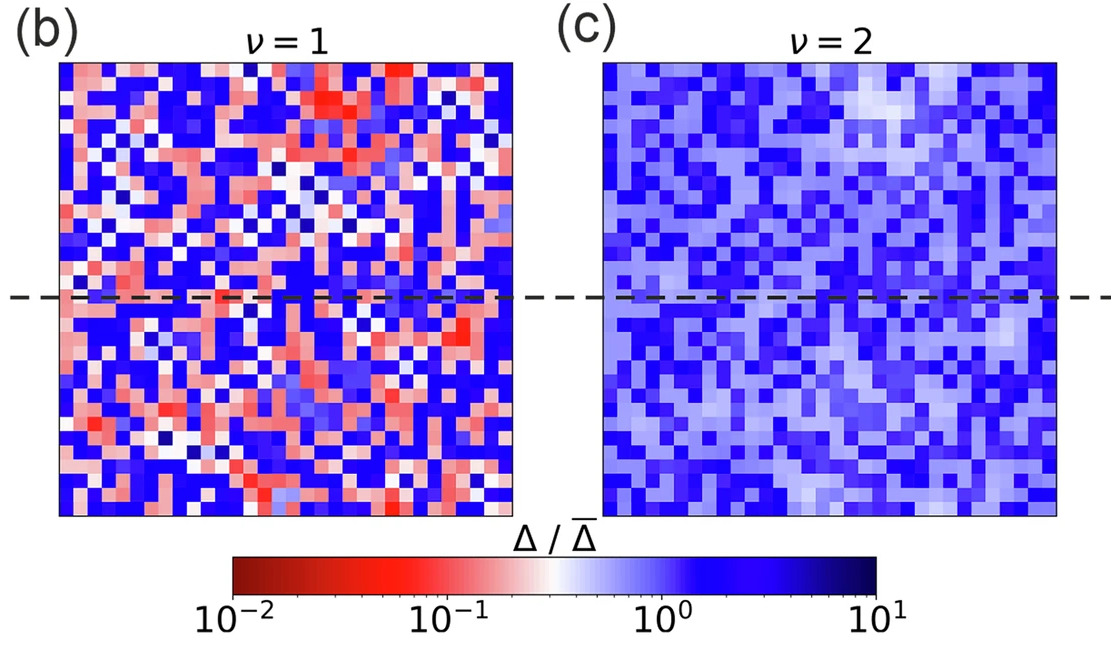
Calculations confirm that this approach is effective for various types of disorder, ranging from random impurities to specially engineered superlattices. It is particularly promising for multilayer materials, where clean and disordered layers can be alternated; for compounds based on magnesium and boron (MgB₂), in which one electronic band enhances local superconductivity while the other facilitates current flow; and for materials with flat electronic bands, where electron pairing occurs more readily. Graphene- and graphite-based systems are also considered promising, as regular superstructures can form that alter electronic properties and promote stronger superconductivity. In the future, this could enable the development of materials in which defects and impurities do not hinder, but rather enhance, superconductivity.
The study was conducted with support from the Russian Science Foundation (Project 075-15-2025-010) and the HSE Basic Research Programme, using the university's HPC cluster.

See also:

AI Users Earn Up to 41.8% More Than Non-Users
Research conducted by economists at HSE University has revealed a significant correlation between the regular use of GenAI in the workplace and higher pay among Russian employees. The study found that individuals who frequently use GenAI in their professional activities earn notably more than those who reject these new tools or resort to them occasionally. The salary premium for highly qualified specialists reaches 41.8%. The article was published in the Voprosy Ekonomiki journal.
Personal Interest in Doctoral Thesis Topic Most Important for Confidence in Successful Defence
A researcher at HSE University analysed data on 1,539 doctoral students from 161 Russian universities to identify which features of a thesis topic are associated with academic success and engagement. The most important factor was found to be personal interest in the research topic, which was associated with almost all key aspects of doctoral programme experience—from engaging with the academic supervisor to research activity and confidence about successfully defending the thesis. The findings have been published in Higher Education.
Researchers Develop Methodology to Assess the Quality of Legal Representation in Criminal Proceedings
Having a good defence attorney in criminal proceedings can largely determine whether a defendant retains their freedom, health and good name. Researchers at HSE University propose a method for predicting an attorney’s performance based on the outcomes of their previous cases. The methodology takes into account the severity of the charges, the complexity of the cases, and the most likely outcome, drawing on judicial statistics.
When Pictures Hinder Understanding: Illustrations May Impede Learning of Abstract Ideas
Illustrations can help remember specific actions but do not always make abstract ideas easier to learn. Researchers from HSE University and Humboldt University compared how people learn from texts with different levels of abstractness. They found that participants remembered illustrations better and performed better on related tasks after reading a multimedia text about yoga asanas than after reading an abstract text about the Nash equilibrium. The findings could help improve the selection of illustrations for educational and informational materials. The study has been published in Learning and Instruction.
HSE Researchers Present Study on Neural Network Robustness in Video Analysis at ChinaMM 2026
Researchers from HSE University presented a study at the international ChinaMM 2026 conference on how video transmission distortions affect the performance of neural networks. The authors proposed a new approach to testing the robustness of such models under conditions that closely resemble the real-world use of video services.
HSE University to Develop Predictive Analytics System for Icebreaker Motors
Industrial automation is one of the key applications of artificial intelligence. A predictive analytics system for large electric motors is among the solutions being developed for the industry as part of HSE University’s Strategic Technological Project ‘Multi-Agent Platform of AI Solutions for Industry-Specific Tasks.’ What is predictive analytics, how can it improve the operation of electric motors, and what specialists joined forces to develop this technology? Anton Zarubin, Dean of the School of Computer Science, Physics, and Technology at HSE University–St Petersburg and the project development coordinator, explains in this interview with the HSE News Service.
Scientific Expedition to Hainan: HSE Scientists Organise Conference on Statistical AI in China
The Statistical AI Conference was held in Sanya, Hainan Island, China, from 24 to 28 August 2026. The international event brought together leading experts in statistics, machine learning, and applied AI. Alexey Naumov, Director of the AI and Digital Science Institute at the HSE Faculty of Computer Science, and Sergey Samsonov, Head of the International Laboratory of Stochastic Algorithms and High-Dimensional Inference, were among the conference organisers.
How to Assess Students’ Knowledge in the Age of AI
A researcher at HSE University has proposed a flowchart to help lecturers decide how to assess students who use artificial intelligence. It shows where the use of AI should be restricted and where it can be incorporated into the learning process. The article has been published in IT Professional.
5th Fall into ML Conference to Bring Together Leading AI Researchers
The AI and Digital Science Institute at the HSE Faculty of Computer Science invites researchers, developers and everyone shaping the future of technology to the fifth, anniversary edition of the Fall into Machine Learning conference (Fall into ML 2026). The event will take place on October 23–24, 2026, at the HSE Cultural Centre in Moscow and will become the key meeting point for Russia’s AI community.
HSE University Expands Cooperation with Malaysia in Technology Foresight
HSE University researchers will take part in a study of the future of engineering education in Malaysia, while the Malaysian Industry-Government Group for High Technology (MIGHT) will use the iFORA big-data analysis system to validate the findings of its foresight research. These are the outcomes of a visit by HSE representatives to Kuala Lumpur.