

HSE and China’s Top Universities to Launch Large-Scale Research and Education Projects
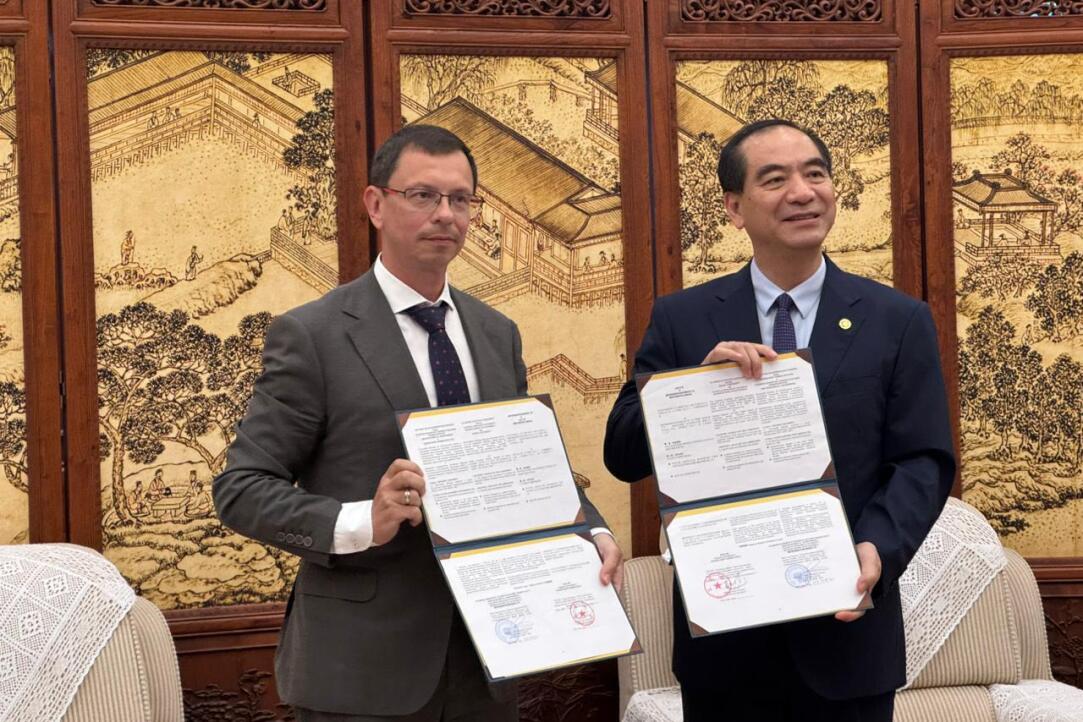
As part of the official visit of Russian President Vladimir Putin to the People’s Republic of China, the HSE delegation led by Rector Nikita Anisimov concluded new cooperation agreements with major Chinese universities. The agreements are designed to expand bilateral partnerships in education, science, and cultural exchange.
During the visit, the HSE University delegation met with the leadership of Tsinghua University, Peking University, and Beijing University of Technology, China’s top scientific and educational centres.

HSE Rector Nikita Anisimov
‘The strong overcome obstacles, and the wise overcome the entire journey. Cooperation with leading Chinese universities not only opens up new horizons in scientific research and knowledge exchange for Russian universities but also reinforces our position in the international educational space, serving as a key component of humanitarian cooperation between the Russian Federation and the People’s Republic of China. Together with our Chinese partners, today we took another important step towards mutual progress and prosperity.’
During the negotiations with our Chinese partners, two key agreements were signed. The first agreement with Tsinghua University focuses on the development of joint projects in the field of biology, ranging from molecular and computational neuroscience to AI-assisted big data analysis. This includes the formation of research groups, preparation of research publications, organization of internships for undergraduates and doctoral students, as well as holding of scientific and educational events. HSE doctoral students will have the opportunity to take internships at Tsinghua, while undergraduates will gain access to new academic mobility formats. The two universities also plan to launch dual degree programmes.
The academic exchange agreement signed with Peking University provides for an annual exchange of undergraduate and doctoral students. This document stipulates the procedures for selecting and assisting participants, their accommodation, administrative and visa support, and academic integration at the host institution. The agreement was published on the Kremlin website as one of the documents signed following the talks between the leaders of Russia and China.
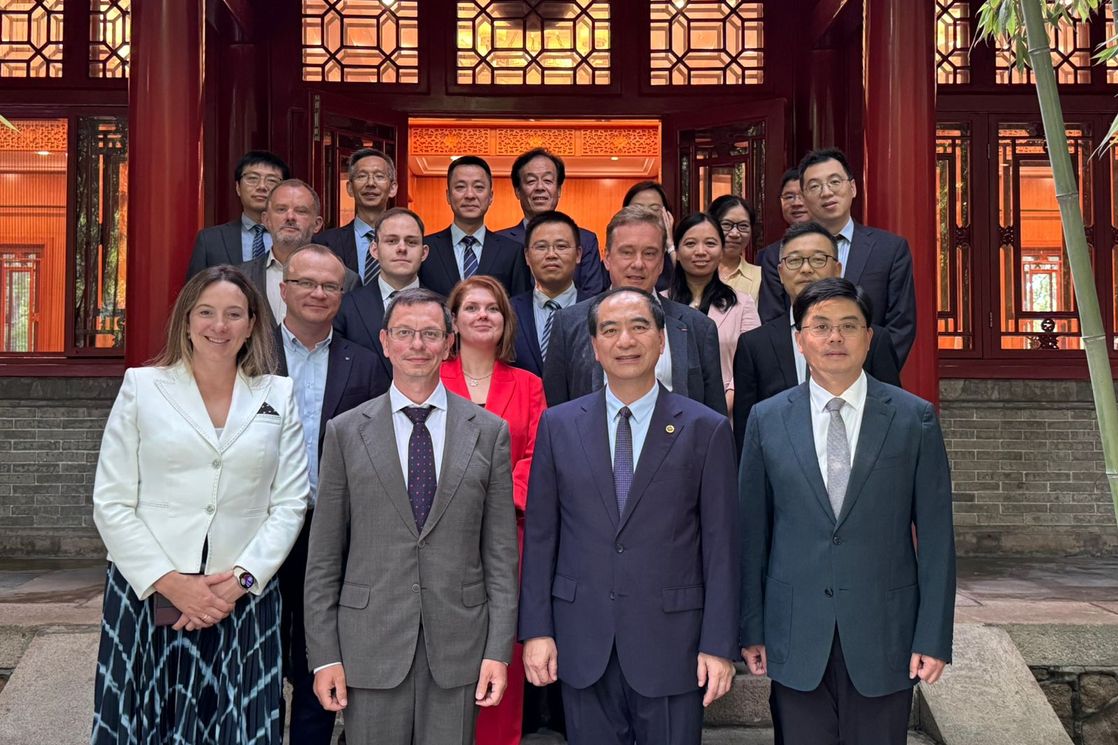
In addition, during their visit, HSE representatives held separate meetings with Peking University units—in particular, with the School of Physics and the School of Management. They discussed the prospects for launching joint educational programmes, developing research initiatives, and participating in international grant competitions. The meetings were attended by HSE Vice Rector Victoria Panova, HSE MIEM Vice Rector and Director Dmitry Kovalenko, HSE MIEM Professor Andrey Vasenko, Dean of the HSE Faculty of Computer Science Ivan Arzhantsev, and Dean of the HSE Faculty of World Economy and International Affairs Anastasia Likhacheva.
The development of humanitarian cooperation and cultural exchange was among the key topics discussed at all the venues. The parties expressed interest in expanding programmes for learning Chinese in Russia and Russian in China, supporting youth initiatives and deepening academic dialogue between university communities.
HSE representatives also met with the university’s students and graduates studying or working in China. During their informal conversation, they shared experiences of participating in academic mobility programmes, talked about their professional plans, and discussed opportunities for future joint projects.

See also:

HSE Researchers Present Study on Neural Network Robustness in Video Analysis at ChinaMM 2026
Researchers from HSE University presented a study at the international ChinaMM 2026 conference on how video transmission distortions affect the performance of neural networks. The authors proposed a new approach to testing the robustness of such models under conditions that closely resemble the real-world use of video services.
HSE University to Develop Predictive Analytics System for Icebreaker Motors
Industrial automation is one of the key applications of artificial intelligence. A predictive analytics system for large electric motors is among the solutions being developed for the industry as part of HSE University’s Strategic Technological Project ‘Multi-Agent Platform of AI Solutions for Industry-Specific Tasks.’ What is predictive analytics, how can it improve the operation of electric motors, and what specialists joined forces to develop this technology? Anton Zarubin, Dean of the School of Computer Science, Physics, and Technology at HSE University–St Petersburg and the project development coordinator, explains in this interview with the HSE News Service.
Scientific Expedition to Hainan: HSE Scientists Organise Conference on Statistical AI in China
The Statistical AI Conference was held in Sanya, Hainan Island, China, from 24 to 28 August 2026. The international event brought together leading experts in statistics, machine learning, and applied AI. Alexey Naumov, Director of the AI and Digital Science Institute at the HSE Faculty of Computer Science, and Sergey Samsonov, Head of the International Laboratory of Stochastic Algorithms and High-Dimensional Inference, were among the conference organisers.
5th Fall into ML Conference to Bring Together Leading AI Researchers
The AI and Digital Science Institute at the HSE Faculty of Computer Science invites researchers, developers and everyone shaping the future of technology to the fifth, anniversary edition of the Fall into Machine Learning conference (Fall into ML 2026). The event will take place on October 23–24, 2026, at the HSE Cultural Centre in Moscow and will become the key meeting point for Russia’s AI community.
HSE University to Present Its Projects at the International Youth Festival
The International Youth Festival (IYF) will be held in Yekaterinburg from 11 to 17 September 2026. HSE University will take an active part in the event. The university's booth will present a space settlement mock-up, robots, and the iFORA big data analysis system. Fifty HSE students will visit festival venues, and experts will participate in the business programme.
HSE University Expands Cooperation with Malaysia in Technology Foresight
HSE University researchers will take part in a study of the future of engineering education in Malaysia, while the Malaysian Industry-Government Group for High Technology (MIGHT) will use the iFORA big-data analysis system to validate the findings of its foresight research. These are the outcomes of a visit by HSE representatives to Kuala Lumpur.
Scientists Train Neural Network to Generate Process Plans from 3D Models
Researchers at the HSE FCS AI and Digital Science Institute have developed CAD2TechSpec, a framework that converts 3D models of mechanical parts into machining process plans—step-by-step instructions for machine tools. The solution aims to reduce the time required for the design and preparation of technical process documentation in mechanical engineering, aircraft manufacturing, and other high-tech industries. The study findings have been published in PeerJ Computer Science.
Biologists Discover 'Molecular Fingerprint' of Preeclampsia
Researchers at HSE University employed a new method to model hypoxia in placental cells during pregnancies complicated by preeclampsia and identified molecular markers of tissue hypoxia. Since hypoxia is one of the key mechanisms underlying preeclampsia, these findings are important for a more accurate and timely diagnosis of the disease and for the development of effective treatment methods. The paper has been published in Placenta.
Laboratory of Future Networks: HSE Telecommunications Research Institute Develops 5G/6G Research Testbed
The 5G/6G testbed at the HSE Telecommunications Research Institute is becoming a research platform, an educational laboratory, and a foundation for developing new software components for future networks. It makes it possible not only to observe how a mobile network operates, but also to change its operating conditions and measure the results: data-transmission speed, latency, errors, radio-resource utilisation, and other parameters. Based on the testbed, researchers plan to develop MIMO, O-RAN, xApp, and IAB technologies, as well as experiment with artificial intelligence.
‘Hedgehog’ Versus ‘Relatives’: Researchers Measure How the Brain Responds to Unexpected Words During Natural Speech
Russian neurophysiologists, including researchers from HSE University, have demonstrated the feasibility of using event-related fields (ERFs) to study brain activity during natural speech perception. The researchers showed that this approach can be applied not only to individual words but also to continuous speech. Their findings indicate that words whose meanings differ significantly from the preceding context require longer processing times. The study also reveals that the brain processes function words in two stages: first, it identifies their grammatical role and then uses this information to predict the next word. The study has been published in Frontiers in Human Neuroscience.