

Scientists Develop Effective Microlasers as Small as a Speck of Dust

Researchers at HSE University–St Petersburg have discovered a way to create effective microlasers with diameters as small as 5 to 8 micrometres. They operate at room temperature, require no cooling, and can be integrated into microchips. The scientists relied on the whispering gallery effect to trap light and used buffer layers to reduce energy leakage and stress. This approach holds promise for integrating lasers into microchips, sensors, and quantum technologies. The study has been published in Technical Physics Letters.
The devices around us are becoming increasingly compact without sacrificing functionality. Smartphones now handle tasks that once required a computer, and small cameras can capture images with quality approaching that of professional equipment. Miniaturisation has also extended to lasers—sources of directed light that are embedded in optical chips, sensors, medical devices, and communication systems.
However, shrinking a laser while preserving its optical properties, efficiency, and reliability remains a significant challenge. Developing a laser measuring 5–8 micrometres—approximately the diameter of a red blood cell—requires complex calculations, and its fabrication demands high precision. The main challenge lies in the design of the laser itself. Unlike conventional light sources, lasers amplify radiation within a resonator—a structure where light is repeatedly reflected and amplified. The more compact the laser, the harder it is to trap the light inside so that it undergoes continuous reflection and amplification without losing energy, which is essential for stable operation.
Another challenge is the presence of defects in the material. Lasers rely on crystals that can amplify light, but microscopic defects often form during their growth, reducing the efficiency of light generation. To minimise these irregularities, scientists carefully select synthesis conditions and simulate the properties of crystals under various scenarios in advance. However, solving one problem often gives rise to others, turning laser development into a continual search for balance.
HSE scientists have developed microlasers with diameters as small as 5 to 8 micrometres that operate at room temperature. The researchers used a crystal structure composed of indium, gallium, nitrogen, and aluminium compounds grown on a silicon substrate. To trap light in a tiny space, the scientists relied on the whispering gallery effect.

Eduard Moiseev
'This phenomenon is well-known in acoustics: in some churches and cathedrals, you can whisper words against one wall, and the sound will be clearly heard on the opposite wall—even though, under normal conditions, the sound would not travel that far. A similar effect enables light to be repeatedly reflected inside the disk-shaped microlaser, minimising energy loss,' explains Eduard Moiseev, Senior Research Fellow at the International Laboratory of Quantum Optoelectronics, HSE University–St Petersburg.
However, even under these conditions, light waves can partially escape into the substrate and be lost. To prevent this, the researchers added a stepped buffer layer, which compensates for mechanical stresses between the silicon and nitride layers and reduces radiation leakage, enabling the laser to operate stably even at such small sizes.

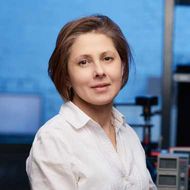
Natalia Kryzhanovskaya
'Our microlasers operate stably at room temperature without the need for cooling systems, making them convenient for real-world applications. In the future, such devices will enable the creation of more compact and energy-efficient optoelectronic technologies,' explains Natalia Kryzhanovskaya, Head of the International Laboratory of Quantum Optoelectronics at HSE University–St Petersburg.
The paper has been prepared as part of a project implemented within the framework of the International Academic Cooperation competition at HSE University.

See also:

HSE University to Develop Predictive Analytics System for Icebreaker Motors
Industrial automation is one of the key applications of artificial intelligence. A predictive analytics system for large electric motors is among the solutions being developed for the industry as part of HSE University’s Strategic Technological Project ‘Multi-Agent Platform of AI Solutions for Industry-Specific Tasks.’ What is predictive analytics, how can it improve the operation of electric motors, and what specialists joined forces to develop this technology? Anton Zarubin, Dean of the School of Computer Science, Physics, and Technology at HSE University–St Petersburg and the project development coordinator, explains in this interview with the HSE News Service.
How to Assess Students’ Knowledge in the Age of AI
A researcher at HSE University has proposed a flowchart to help lecturers decide how to assess students who use artificial intelligence. It shows where the use of AI should be restricted and where it can be incorporated into the learning process. The article has been published in IT Professional.
5th Fall into ML Conference to Bring Together Leading AI Researchers
The AI and Digital Science Institute at the HSE Faculty of Computer Science invites researchers, developers and everyone shaping the future of technology to the fifth, anniversary edition of the Fall into Machine Learning conference (Fall into ML 2026). The event will take place on October 23–24, 2026, at the HSE Cultural Centre in Moscow and will become the key meeting point for Russia’s AI community.
HSE University Expands Cooperation with Malaysia in Technology Foresight
HSE University researchers will take part in a study of the future of engineering education in Malaysia, while the Malaysian Industry-Government Group for High Technology (MIGHT) will use the iFORA big-data analysis system to validate the findings of its foresight research. These are the outcomes of a visit by HSE representatives to Kuala Lumpur.
Scientists Train Neural Network to Generate Process Plans from 3D Models
Researchers at the HSE FCS AI and Digital Science Institute have developed CAD2TechSpec, a framework that converts 3D models of mechanical parts into machining process plans—step-by-step instructions for machine tools. The solution aims to reduce the time required for the design and preparation of technical process documentation in mechanical engineering, aircraft manufacturing, and other high-tech industries. The study findings have been published in PeerJ Computer Science.
Biologists Discover 'Molecular Fingerprint' of Preeclampsia
Researchers at HSE University employed a new method to model hypoxia in placental cells during pregnancies complicated by preeclampsia and identified molecular markers of tissue hypoxia. Since hypoxia is one of the key mechanisms underlying preeclampsia, these findings are important for a more accurate and timely diagnosis of the disease and for the development of effective treatment methods. The paper has been published in Placenta.
Laboratory of Future Networks: HSE Telecommunications Research Institute Develops 5G/6G Research Testbed
The 5G/6G testbed at the HSE Telecommunications Research Institute is becoming a research platform, an educational laboratory, and a foundation for developing new software components for future networks. It makes it possible not only to observe how a mobile network operates, but also to change its operating conditions and measure the results: data-transmission speed, latency, errors, radio-resource utilisation, and other parameters. Based on the testbed, researchers plan to develop MIMO, O-RAN, xApp, and IAB technologies, as well as experiment with artificial intelligence.
‘Hedgehog’ Versus ‘Relatives’: Researchers Measure How the Brain Responds to Unexpected Words During Natural Speech
Russian neurophysiologists, including researchers from HSE University, have demonstrated the feasibility of using event-related fields (ERFs) to study brain activity during natural speech perception. The researchers showed that this approach can be applied not only to individual words but also to continuous speech. Their findings indicate that words whose meanings differ significantly from the preceding context require longer processing times. The study also reveals that the brain processes function words in two stages: first, it identifies their grammatical role and then uses this information to predict the next word. The study has been published in Frontiers in Human Neuroscience.
HSE Researchers Create New Corpus of Early Child Speech in Russian
Researchers at the HSE Centre for Language and Brain have presented RusLan-M, an open multimedia corpus that makes it possible to trace the development of early child speech in Russian from first words to the emergence of complex grammatical constructions. The database contains around 41 hours of video recordings and more than 35,000 child utterances. The new resource will help researchers study more precisely how children acquire Russian and, in the longer term, develop more reliable tools for assessing speech development. The study has been published in Language Resources and Evaluation.
Hybrid Intelligence: Competencies in the Age of AI Discussed at Technoprom-2026
Artificial intelligence is not creating new professions, but rather transforming the nature of existing ones. This was the conclusion reached by participants in the panel session ‘Hybrid Intelligence: Digital and Human Drivers of Development,’ organised by the Institute for Statistical Studies and Economics of Knowledge (ISSEK) at HSE University as part of the 13th International Forum of Technological Development (Technoprom-2026). The experts discussed how the nature of work is changing, which skills are becoming increasingly sought after, and what prevents companies from fully capitalising on new technologies.