

HSE Scientists Explain How to Identify Brain Areas Critical for Language Function During Surgery

The HSE Centre for Language and Brain conducted a course on tractography, a method that enables visualisation of key brain connections and helps surgeons avoid damaging language-critical areas during surgery. The course was attended by neurosurgeons and radiologists from Moscow and other Russian regions who are interested in methods of preoperative language mapping.
Tractography is a technique for constructing 3D models of the brain’s pathways using diffusion-weighted MRI data. In the brain’s white matter, water primarily diffuses along nerve fibres, and this directionality can be reconstructed using specialised algorithms. One such method is diffusion tensor imaging (DTI), which allows researchers to assess the degree of water molecule diffusion alignment and to map the brain’s white matter tracts.
During the training course, participants not only discussed various theoretical issues related to preoperative and intraoperative mapping of language function and tracts but also gained hands-on experience in manually reconstructing models using the TrackVis software tool, based on pre-processed structural MRI images.
A dedicated lecture focused on linguistic tests for intraoperative mapping, a technique used by clinicians to identify language areas during surgery.

'Localising language function is a critical step in planning surgical interventions for patients with lesions in the language-dominant hemisphere. Experts at the Centre for Language and Brain have accumulated significant experience in preoperative language mapping, which minimises the risk of complications and improves the effectiveness of surgical interventions. We are pleased to share our knowledge and practical recommendations with our surgical colleagues to advance modern neurosurgery and improve the quality of patient care,' said Anna Komissarenko, Junior Research Fellow at the HSE Centre for Language and Brain.
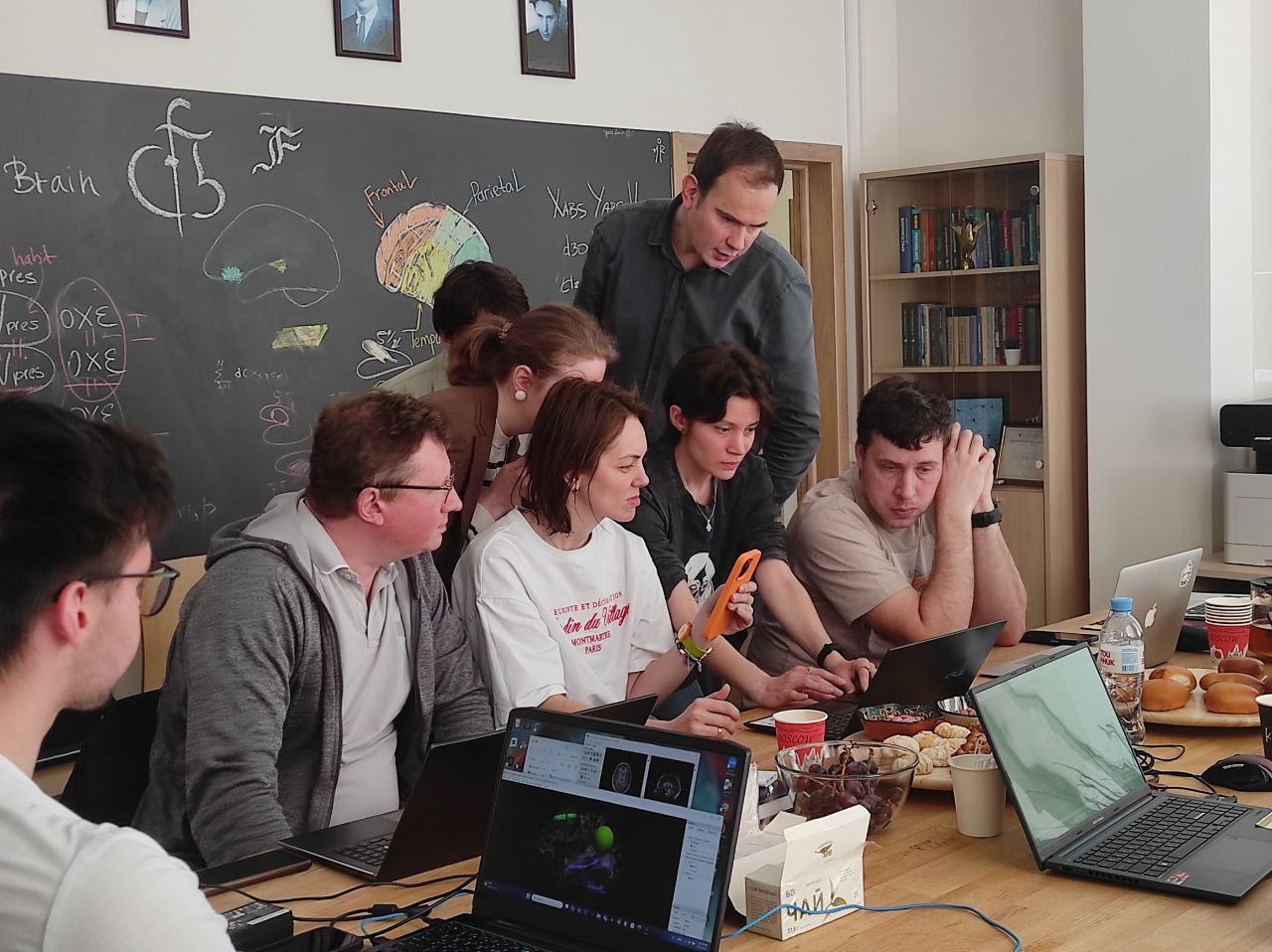
The HSE Centre for Language and Brain has extensive expertise in providing linguistic support for neurosurgical patients. An important focus of the centre’s work is the development of specialised linguistic tests to identify functionally significant language areas during the planning and performance of neurosurgical operations. The centre’s specialists are investigating how the brain’s language function reorganises in cases of tumours and epilepsy, with special emphasis on the role of white matter pathways in supporting language function. The findings are used in both research and clinical practice—during preoperative mapping and intraoperative language monitoring. The practical course generated great interest among participants and served as a platform for interdisciplinary dialogue between neurolinguists and clinicians.
Anastasia Parshunina, neurosurgeon
'During surgery, it is essential to balance the radicality of the operation with the patient’s functional status. When removing a tumour near the language area in a patient with intact language function, it is crucial that the patient retains the ability to speak and understand speech after treatment. Therefore, the ability to reconstruct tracts is essential for preoperative treatment planning and for understanding the relationship between the tumour and functionally significant structures. The course deepened our understanding of anatomical principles and demonstrated the potential of 3D modelling for preoperative planning. We are thankful to the course organisers. During the two-day course, we gained valuable theoretical knowledge and practical skills in reconstructing pathways using the TrackVis software.
The Centre for Language and Brain thanks all course participants and invites everyone to stay updated on upcoming courses and educational programmes.

See also:

Scientists Train Neural Network to Generate Process Plans from 3D Models
Researchers at the HSE FCS AI and Digital Science Institute have developed CAD2TechSpec, a framework that converts 3D models of mechanical parts into machining process plans—step-by-step instructions for machine tools. The solution aims to reduce the time required for the design and preparation of technical process documentation in mechanical engineering, aircraft manufacturing, and other high-tech industries. The study findings have been published in PeerJ Computer Science.
Biologists Discover 'Molecular Fingerprint' of Preeclampsia
Researchers at HSE University employed a new method to model hypoxia in placental cells during pregnancies complicated by preeclampsia and identified molecular markers of tissue hypoxia. Since hypoxia is one of the key mechanisms underlying preeclampsia, these findings are important for a more accurate and timely diagnosis of the disease and for the development of effective treatment methods. The paper has been published in Placenta.
‘Hedgehog’ Versus ‘Relatives’: Researchers Measure How the Brain Responds to Unexpected Words During Natural Speech
Russian neurophysiologists, including researchers from HSE University, have demonstrated the feasibility of using event-related fields (ERFs) to study brain activity during natural speech perception. The researchers showed that this approach can be applied not only to individual words but also to continuous speech. Their findings indicate that words whose meanings differ significantly from the preceding context require longer processing times. The study also reveals that the brain processes function words in two stages: first, it identifies their grammatical role and then uses this information to predict the next word. The study has been published in Frontiers in Human Neuroscience.
Hybrid Intelligence: Competencies in the Age of AI Discussed at Technoprom-2026
Artificial intelligence is not creating new professions, but rather transforming the nature of existing ones. This was the conclusion reached by participants in the panel session ‘Hybrid Intelligence: Digital and Human Drivers of Development,’ organised by the Institute for Statistical Studies and Economics of Knowledge (ISSEK) at HSE University as part of the 13th International Forum of Technological Development (Technoprom-2026). The experts discussed how the nature of work is changing, which skills are becoming increasingly sought after, and what prevents companies from fully capitalising on new technologies.
Scientists Develop New Solution for 6G Communication Systems
A terahertz neuromorphic circuit developed by scientists at HSE University could make 6G communication systems both more accurate and energy-efficient. The circuit enables indoor tracking of mobile devices with an accuracy of up to 99%. The results were presented at PIERS 2026, an international symposium on Photonics and Electromagnetism held in China.
Scientists Develop Algorithm for More Reliable Processors in Data Centres
Researchers from HSE MIEM and Samara University have developed the LRF-3D algorithm to automatically bypass idle nodes in three-dimensional networks-on-chip. Thanks to its hierarchical architecture, the algorithm outperforms existing solutions in both speed and path accuracy, improving processor reliability for use in data centres, supercomputers, and AI computing. The source code and test results are publicly available.
Researchers Develop Method for Direct Generation of Regulatory DNA
Researchers at HSE University have developed a model for generating promoters and enhancers—DNA sequences that regulate gene activity. The model works directly with DNA nucleotides, without first transforming them into a continuous numerical representation. This solution could be useful for applications in synthetic biology and gene therapy. The study results were presented at the ICLR 2026 Workshop ‘Generative AI in Genomics (Gen^2): Barriers and Frontiers.’
Researchers at HSE University and Sber Train Neural Networks to Better Predict User Preferences
The HSE FCS AI and Digital Science Institute and Sber have introduced a new architecture for recommendation systems that combines two classes of models, enabling algorithms to better predict users’ interests and needs. A preprint of the paper has been published on arxiv.org and presented at Urban ML.
Social Integration: At the Crossroads of Knowledge and Values
The International Laboratory for Social Integration Research (ILSIR) at HSE University studies the challenges faced by vulnerable groups and explores ways to help them participate fully in everyday life. To develop effective solutions, the laboratory’s researchers combine cutting-edge methods with practical fieldwork. In this interview with the HSE News Service, Laboratory Head Elena Iarskaia-Smirnova discusses the laboratory’s work.
Physicists Discover What Happens Inside a Stable Vortex
Large vortices with characteristic spiral arms are often observed in the atmosphere and the ocean. Physicists from HSE University have explained how these structures form and why they retain their shape. The researchers found that velocities at points located along the same vortex arc remain correlated even over long distances. At the same time, this correlation weakens rapidly with increasing distance from the vortex centre. These differences help explain the formation of spiral arms and may improve models of atmospheric and oceanic currents. The findings have been published in Physical Review Fluids.