

Economists and Researchers Gather at International Conference on Wealth and Income in Eastern Europe and CIS Countries


On September 17-18, HSE University hosted a special conference with the International Association for Research in Income and Wealth (IARIW) on the topic of Experiences and Challenges in Measuring Income and Wealth in Eastern Europe and CIS Countries. This was the first IARIW conference to be held in a CIS country. HSE News Service spoke with American economist Barbara Fraumeni about her work with economic accounting and human capital and her experience attending the conference in Moscow.
In addition to a biennial general conference held in even-numbered years, the International Association for Research in Income and Wealth (IARIW) holds special conferences in odd-numbered years that focus on specific regions. This year’s special conference, held with the support from Interstate Statistical Committee of the Commonwealth of Independent States (CIS Stat) and the Federal State Statistics Service of the Russian Federation (Rosstat), focused on issues related to national accounts, prices, productivity, income and wealth distribution, poverty, and economic wellbeing in Eastern Europe and the Commonwealth of Independent States (CIS). Participants examined past experiences, presented analyses, and identified future measurement challenges. The conference drew economists and researchers from Eastern Europe, countries of the CIS, as well as North America, Europe, and Asia.
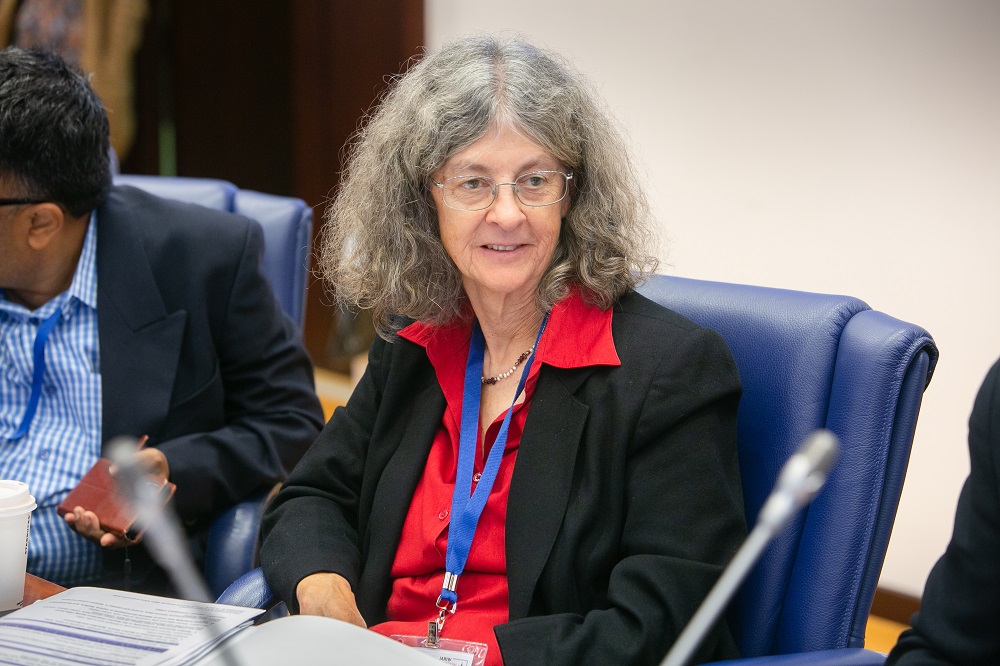
© Mikhail Dmitriev/ HSE University
Dr Barbara Fraumeni, a member and former president of the IARIW
The IARIW, which hosts this conference, is really the field organization for people who do the things I do. There are two big groups. One group does things like income distribution, inequality, and well-being, using very micro data. And then you have my half which is more focused on productivity, economic growth. While we also use detailed data, we do not use data that is at the one-person level, so there are really two sides to it. As a former chair of the IARIW, I very much enjoy coming to these conferences and I’ve known Professor Ilya Voskovoynikov, the co-organizer of this event from HSE, for a number of years. So that’s why I’ve decided to take part.
One purpose of this conference is to provide opportunities for people to present this type of research. Economic accounting is not a ‘sexy’ area of research
It is not even included in the US listing of all the different areas in economics—a list that includes probably 500 categories. So to have an opportunity to come here and present your work in this area and to hear other people who are the experts who can expose you to what you might be able to do and then to get you excited about doing it in the future is a wonderful thing. At the conference we had about 200 people, which is a very high number. Usually at these types of conferences there are about 100.
I have worked with students from the former Soviet Union at the Muskie School, so I have some interest in this area. There was a talk on the history of the Soviet Union that was fascinating. I don’t have any papers on Russia or the former USSR - I’ve never covered those areas.
So listening to presenters here, I began to wonder about how much data there is available for studying human capital in Russia
I served as a discussant for productivity-related papers here at the conference. I reviewed a paper on Poland, and I reviewed a paper comparing India to Russia. The diversity of what’s going on still is what’s interesting. I went to all the sessions and enjoyed them thoroughly, including the ones on wealth distribution and inequality.
Not a Typical Economist
I’m not a typical economist. A typical economist uses a lot of econometrics—mathematical modelling where you try to predict based on certain variables that you have. I don’t do that. I tell people I’m an economist-accountant - I just use the numbers; they have to be put together in particular ways, so there is math behind it, but very few economists do what I do.
Human Capital
My main research interest is human capital, which is something I worked on with Professor Dale Jorgenson of Harvard University a long time ago. What I mean by human capital is what you get when you take everybody in the country and look at a range of factors—their current education and their expected future education, how long they’re expected to live (birth rates, etc.), whether they expected to work, both now and in the future, and so on—and you determine their current income and can predict their expected income for their whole lifetime. You can do this even for someone who has even just been born.
But since you’re doing this for the future, you have to, as they say, discount it to the present. For example, if you got $10,000 today or $10,000 in five years, you would always take $10,000 today because you could invest it and earn interest. But if you reverse that process, you would need whatever that might be—let’s say, $8,000 today—to have the equivalent of $10,000 five years from now. That means that the future incomes are worth less today. So you do all that and you basically have a summary of the potential of the whole country.
Because of data limitations, however, except for a few countries, such as the US, I don’t look at economic activity for which people aren’t paid. So, except for in the US, I don’t look at the value of taking care of children or cooking or even leisure time – everybody needs some leisure time. In Russia, for example, there’s no way I would be able to do that extension. But I do believe that extension is very important.
In fact, I got into human capital because I believe that the rate of growth of GDP was being over-estimated
In the US, by 1980, women were moving into the labour force at higher rates. But what was really happening was that their economic activity was just switching from the home to the marketplace, so to speak, so it looked like GDP was really growing. However, if you took the total amount of economic activity, while it was indeed increasing a little bit due to hired babysitters or families’ eating out more, the level of economic activity in actuality hadn’t gone up that much.
So I think it’s really important to count the stuff that you do when you’re not being paid to do it. It just takes a lot more data to do that. So, that’s the longer story I guess. This is the Jorgenson-Fraumeni approach to human capital. Today our approach is one of two methodologies used by the World Bank.
Introducing the Jorgenson-Fraumeni Approach to China
My work in China began completely independently of my university work in the US. How it all came about was a graduate student in Beijing emailed me a question. There was a typo in one of my papers and she didn’t understand something in the paper as a result of that. And she immediately invited me to come to Beijing. So I said, sure. During my visit, I toured around, because I assumed I would never be back to China.
Later, however, a colleague of mine established a centre, the China Center for Human Capital and Labor Market Research, at the Central University of Finance and Economics (CUFE) in Beijing. As part of his proposal for the centre, he said that the centre would produce an estimate of human capital in China. The Chinese government responded positively. However, they said that they needed an estimate not in three years but in six months, for the October anniversary of the founding of the People’s Republic. So suddenly we are in panic mode. I came to China and did some presentations. It must have been in May, and they had until October. They did not tell me until about an hour or so before I was going to leave the campus to fly back to the US that they had decided to use my methodology. But I knew from talking to them that they really didn’t know how to do it—yet. So, after many, many emails back and forth—I didn’t even get a flight to come back for the release until I was convinced that they could do it sufficiently well to present—they managed to do it. There was a Nobel Prize winner at the release – it was a huge release. There were about 800 people, including Professor Jorgenson. It was a big deal. And I had the pleasure of meeting the only female member of the politburo. I was thrilled!
Dr Fraumeni is a Special-Term Professor of the Central University of Economics and Finance in Beijing, Professor Emerita of the Muskie School of the University of Southern Maine (USA), Senior Fellow of Hunan University in Changsha, China, and former Chief Economist in the US Bureau of Economic Analysis in the US Department of Commerce (1999-2005).

Ilya Voskoboynikov
Assistant Professor at the Department of Applied Economics
See also:

HSE Economist Finds Way to Improve Efficiency of Stock Market Trading Strategies
An economist at HSE University has analysed possible trading strategies on the stock market and shown that investors can achieve higher returns if they determine the size of their trades based on the degree of intraday fluctuations in asset prices. When the key interest rate is high, the advantage of this strategy over a conventional one increases 4.7-fold. The study has been published in the journal Enterprise Development and Microfinance.
‘I Dream of Simple Things’
Anastasia Gergenreter specialises in applied statistics and econometrics. In this interview for the Young Scientists of HSE University project, she talked about why she studies addictive substance use, two very different Fishers, and the cherry blossom season at the Main Botanical Garden in Moscow.
Economists Propose More Effective Approach to Reducing Smoking
Economists at HSE University have examined how smokers respond to changes in cigarette prices. When tobacco prices increase, cigarette consumption does not always decline. In fact, spending on tobacco may even rise: according to the researchers, a 1% decrease in cigarette affordability leads to a 0.28% increase in per capita tobacco expenditure. The findings suggest that to reduce smoking rates, tobacco prices must rise faster than household incomes. The study has been published in Voprosy Statistiki.
HSE Economists Use Search Queries to Forecast Birth Rates
Researchers from the HSE Faculty of Economic Sciences have shown that the accuracy of birth rate forecasts for Russia can be improved by almost 50% by incorporating the dynamics of online search queries related to pregnancy and childbirth into forecasting models. In the best-performing models, the forecasting error fell from 4.6% to 3.2%. The findings have been published in Populations and Economics.
‘To Keep Pace with Technology, Foresight Itself Must Become Faster’
The Innovation and Technology Management Conference (InnoTech 2026), organised by Elsevier publishing house in partnership with Tsinghua University, has taken place in Beijing. The event focused on the challenges of managing technological development in the age of artificial intelligence. Olesia Maibakh and Danil Yatskin, researchers from the International Research and Educational Foresight Centre at the HSEInstitute for Statistical Studies and Economics of Knowledge (ISSEK), presented the findings of the large-scale foresight study ‘IT in Russia: Development Scenarios’ conducted with the support of Yandex.
Experiments in Economics
Why simulate an auction? How do experiments in economics differ from those in psychology? Assistant Professor Alexander Usvitskiy, Head of the Laboratory for Experimental Economics and Finance, discusses the laboratory's activities and research approaches.
When Circumstances Are Stronger Than Habits: How Financial Stress Affects Smoking Cessation
HSE researchers have found that the likelihood of quitting smoking rises with increasing financial struggles. While low levels of financial difficulties do not affect smoking behaviour, moderate financial stress can increase the probability of quitting by 13% to 21%. Responses to high financial stress differ by gender: men are almost 1.5 times more likely to give up cigarettes than under normal conditions, whereas no significant effect is observed on women’s decisions to quit smoking. These conclusions are based on data from the Russia Longitudinal Monitoring Survey (RLMS-HSE) for 2000–2023 and have been published in Monitoring of Public Opinion: Economic and Social Changes.
‘Sometimes a Student’s Question Will Spark a New Angle on a Problem I’ve Been Working on’
Nicolas Lagios joined the International College of Economics and Finance (ICEF) at HSE University–Moscow as an assistant professor in 2025. He holds a Master’s and a PhD in Economics and his research interests include political economy, cultural economics, and applied economics. In this interview, Nicolas talks about the qualities that make HSE students exceptional, the overlap between organisational psychology and his research, and why Moscow strikes the ideal work–life balance.
AI Overestimates How Smart People Are, According to HSE Economists
Scientists at HSE University have found that current AI models, including ChatGPT and Claude, tend to overestimate the rationality of their human opponents—whether first-year undergraduate students or experienced scientists—in strategic thinking games, such as the Keynesian beauty contest. While these models attempt to predict human behaviour, they often end up playing 'too smart' and losing because they assume a higher level of logic in people than is actually present. The study has been published in the Journal of Economic Behavior & Organization.
Banking Crises Drive Biodiversity Loss
Economists from HSE University, MGIMO University, and Bocconi University have found that financial crises have a significant negative impact on biodiversity and the environment. This relationship appears to be bi-directional: as global biodiversity declines, the likelihood of new crises increases. The study examines the status of populations encompassing thousands of species worldwide over the past 50 years. The article has been published in Economics Letters, an international journal.