

'Our University Is Growing Together with the April Conference'
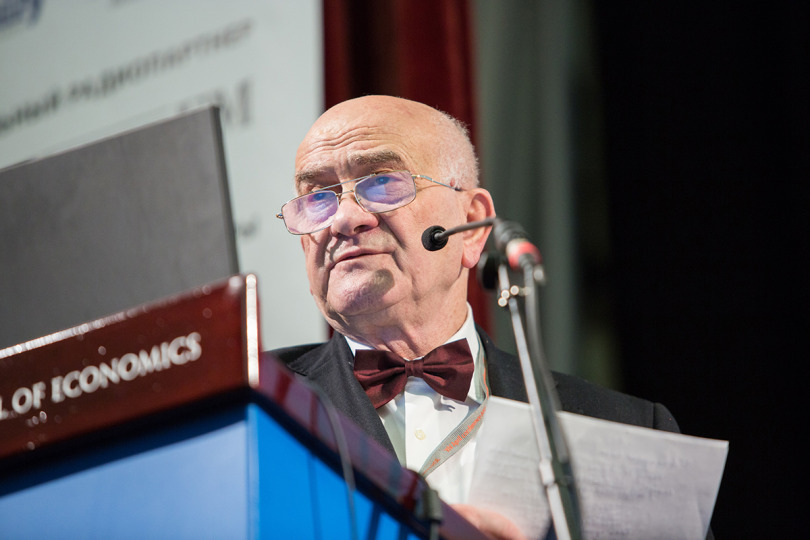
April 19th marks the official start of the XVII April International Academic Conference on Economic and Social Development. Below, HSE Academic Supervisor Evgeny Yasin, who is also the Chairman of the Conference’s Programme Committee, discusses what participants can expect from this year’s conference.
In a certain sense, the April Conference is a type of business card for the Higher School of Economics. Most of the conferences that international universities hold typically focus on either classical or applied science, but such conferences have practically no agenda for large-scale reforms. This is what makes the HSE’s April Conference unique; it plays an active role in the transformations that are taking place in our country. Our university has grown together with the April Conference – starting with the fairly narrow spectrum of problems that had to be overcome throughout the process of reform and ending with the point at which we could consider ourselves to be equal participants in the global academic process as concerns economics and its related disciplines.
Our conference, like our university, is a living organism in that we’re constantly growing and changing. This year, the conference’s plenary sessions, of which there are many, will take place in a new format. It truly is a great thing to see HSE alumni participate in the academic discussions, and there are more and more of them every year. Some key alumni taking part in this year’s plenary session on macroeconomics are Maxim Oreshkin, Russian Deputy Finance Minister, and Konstantin Noskov, the Head of the Analytical Centre for the Government of Russia.
This year we’ve decided to take an important step in the evolution of the Conference
This session will open the conference and be of particular interest not only because of its participants, who include the Deputy Chairman and Chief Economist of Vnesheconombank, Andrei Klepach, but also because of the papers being presented. Key presenters include Evsei Gurvich, who is the Head of the Economic Expert Group, and First Deputy Governor of the Russian Central Bank, Ksenia Yudaeva.
Overall, all of the plenary sessions feature intriguing papers that, I hope, inspire substantive discussions. The conference will include papers by researchers from outside the Higher School of Economics as well. I am personally looking forward to the paper Lev Gudkov*, Director of the Levada Center*, is presenting at the session on Wealth and the Dynamics of Social Structure. And, of course, we can all look forward to the paper Victor Polterovich, Mathematical Economics Laboratory Chief at the RAS Central Economics and Mathematics Institute (CEMI), is planning to present at the session on Values, Institutions, and Trust. This session will also feature talks by the Dean of Moscow State University’s Economics Faculty, Alexander Auzan; HSE Professor Alexander Arkhangelsky*; and, we are hoping, Alexei Kudrin, who is the Dean of the Faculty of Liberal Arts and Sciences at St. Petersburg State University.
In addition, I would like to propose a topic for discussion: how institutional reform programmes should depend on civil culture

Victor Polterovich
Mathematical Economics Laboratory Chief at CEMI
And of course, I’d also like to invite everyone to attend the session featuring the paper, “The Russian Economy: Problems, Solutions, Consequences,” authored by Natalia Akindinova, Yaroslav Kuzminov, and myself. In this paper, we have come up with four possible trajectories for our economy, and we discuss the likelihood of these scenarios based on a survey of various experts.
I also consider Lilia Ovcharova’s paper on investing in human capital to be very important. She’ll present the paper at the plenary session on social policy.
All political parties can consider this paper to be our view on entering a growth trajectory
Lilia Ovcharova
HSE Director for Social Studies
This year’s sessions cover practically all economic disciplines studied at HSE: economics, macroeconomics, microeconomics, industrial markets, etc. New sessions are arising as well, and we are not just pulling them out of thin air. The April Conference’s programme is developed in two stages. In the first stage, we collect all of the proposals that researchers send us, and we group them into blocks. In the second stage, with the opinions of our researchers in mind, we identify the most important topics and reach out to the experts we’d like to see at the conference. Such a combinatory approach yields the most interesting results.
* Решением Минюста РФ Левада-Центр включён в реестр некоммерческих организаций, выполняющих функции иностранного агента.* A. Arkhangelsky (Александр Архангельский) и Lev Gudkov (Лев Гудков) включены Минюстом в Реестр иностранных агентов.

See also:

HSE Researchers Compile Scientific Database for Studying Children’s Eating Habits
The database created at HSE University can serve as a foundation for studying children’s eating habits. This is outlined in the study ‘The Influence of Age, Gender, and Social-Role Factors on Children’s Compliance with Age-Based Nutritional Norms: An Experimental Study Using the Dish-I-Wish Web Application.’ The work has been carried out as part of the HSE Basic Research Programme and was presented at the XXVI April International Academic Conference named after Evgeny Yasin.
China Bets on Expanding Leading Universities, Postgraduate Education, and STEM Fields
At the XXVI April International Academic Conference named after Evgeny Yasin at HSE University, one of the distinguished speakers was Prof. Liguo Li of the School of Education at Tsinghua University. He spoke about changes in the structure of higher education in China in line with national strategic priorities, including a proposed 1.7–2-fold increase in the number of leading research universities.
Scholar Explains How States Can Build Governance in Era of Mega-Shifts
How can states maintain governability and stability in a world where established rules are rapidly losing their force? Prof. Ali Farazmand of Florida Atlantic University answered this question in a presentation delivered at the XXVI April International Academic Conference named after Evgeny Yasin. The scholar proposed examining the transformation of the global order through the lens of two ‘mega-shifts’—from the rise of global corporate capitalism to the emerging multipolarity of today—and demonstrated why this transition between eras requires fundamentally new approaches to governance.
Supercomputers as Superheroes: How High-Performance Computing Is Saving the World
Modern supercomputers can perform more than a trillion calculations per second. This immense capacity enables researchers to address problems that were previously intractable. At the XXVI April International Academic Conference, Ilias Kotsireas, a professor at Wilfrid Laurier University, spoke about the potential of high-performance computing in fields such as weather and climate modelling, astrophysics, and medicine.
A Time for Flexible Solutions: How China Trains In-Demand Specialists
Building an effective workforce training system requires not only appropriate institutions, but also well-developed intermediary organisations capable of translating policy into practice and connecting different groups of stakeholders, said Dr Po Yang, Professor at Peking University. She was an invited speaker at the XXVI April International Academic Conference named after Evgeny Yasin.
XXVI April International Academic Conference Kicks Off at HSE University
The conference programme covers five research topics: economics; human capital and society; instrumental methods and models; foresight research; and international research. Hundreds of scientists from around the world will take part in the conference.
Applications for Participation in XXVI April International Academic Conference Still Open
Applications can be submitted on the conference website until December 16, 2025. The programme has been developed around five research themes: Economics, Human Capital and Society, Instrumental Methods and Models, Foresight Research, and International Research. The heads of these areas have presented, in video format, the priority topics and sections for which they are expecting submissions.
Applications to Participate in April International Academic Conference Now Open
HSE University is now accepting proposals to present academic reports at the XXVI April International Academic Conference named after Evgeny Yasin. Applications can be submitted until December 16, 2025. The conference events will take place mainly on-site in Moscow from April 14 to 17, 2026.
24 Countries Represented at 25th Yasin International Academic Conference Held by HSE University
The Programme Committee of the 25th Yasin (April) International Academic Conference on Economic and Social Development has summed up the initial results. In 2025, 1,384 people from 24 countries and 29 Russian regions participated in the conference, with 335 of them delivering presentations.
Stuck in the Net: How Much Time Children Spend Online
On average, a schoolchild spends 48 hours a week on studies—equivalent to a six-day working week for an adult. This was highlighted by experts at the round table ‘Domains of Children’s Well-Being Evaluation for Human Potential and Evidence-Based Social Policy Development,’ held as part of the 25th Yasin (April) International Academic Conference.
Lev Jakobson
HSE First Vice Rector