

Educational Equality is Key to Eliminating Corruption
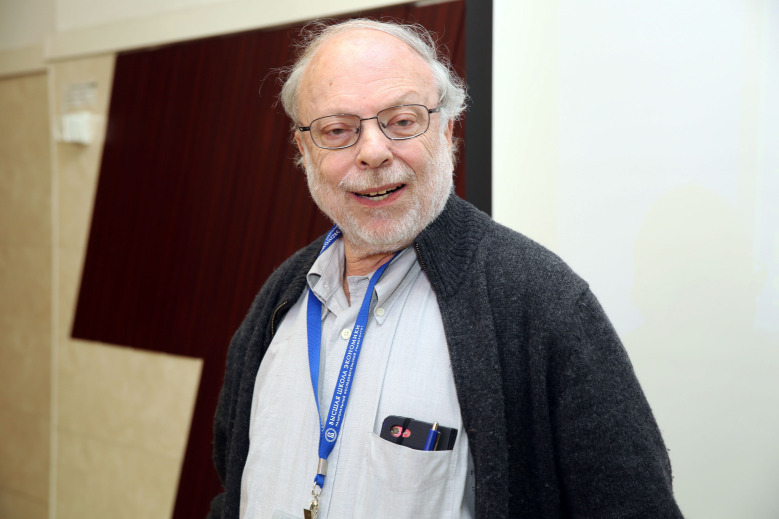
On April 8, Eric Uslaner, Professor of Government and Politics at the University of Maryland - College Park, presented a keynote lecture called ‘The Historical Roots of Corruption’ on the second day of the XVI April International Academic Conference on Economic and Social Development at HSE. Professor Uslaner is a widely recognized expert in political science, with specific interests in political economy, political behaviour, equality, trust and corruption. Among his more recent books is Corruption, Inequality, and the Rule of Law: The Bulging Pocket Makes the Easy Life published by Cambridge University Press in 2008.
One of the main ideas he presented in his lecture at the April Conference was that levels of education across 78 countries in 1870 strongly predict corruption in 2010. Historical levels of education reflect levels of equality across countries, which demonstrate strong ‘path dependence’ over time.
The relationship between historical levels of education and corruption remains strong even when controlling for changes in the level of education, gross national product per capita, and democratic governance. Regime type is generally not significant.
In his presentation, Professor Uslaner traced early education to levels of economic equality in the late 19th to early 21st centuries, arguing that societies with more equality educated more of their citizens. Greater education gave their citizens more opportunities and power, thereby reducing corruption. Historical evidence from Europe and from Spanish, British, and French colonies shows that strong states provided more education to their citizens and that such states were themselves more common where economic disparities were smaller.
Professor Uslaner stressed that countries have responded to major external threats by increasing the level of education, and the need for increased state capacity was a strong motivation for introducing universal education in many countries. Education provided by state also replaced the influence of the church.
Only four countries in the world have truly done a good job in terms of education according to Professor Uslaner: South Korea, Japan, Finland and Italy. Finland improved the level of education in order to break away from the influence of the Soviet Union. Japan had no choice; it had to reform its education system after the Second World War. After the Korean War, South Korea was also forced to prove that it was different, including by means of education reform.
Professor Uslaner also showed the extent to which the level of corruption is closely linked with the level of education. The higher a country’s education level, the less corrupt it is. Societies with more equal education have given citizens more opportunities and power to oppose corruption. During the discussion after the lecture, it was remarked that ‘Nobody likes corruption but some people can’t find a way to avoid it’.

See also:

HSE Researchers Compile Scientific Database for Studying Children’s Eating Habits
The database created at HSE University can serve as a foundation for studying children’s eating habits. This is outlined in the study ‘The Influence of Age, Gender, and Social-Role Factors on Children’s Compliance with Age-Based Nutritional Norms: An Experimental Study Using the Dish-I-Wish Web Application.’ The work has been carried out as part of the HSE Basic Research Programme and was presented at the XXVI April International Academic Conference named after Evgeny Yasin.
China Bets on Expanding Leading Universities, Postgraduate Education, and STEM Fields
At the XXVI April International Academic Conference named after Evgeny Yasin at HSE University, one of the distinguished speakers was Prof. Liguo Li of the School of Education at Tsinghua University. He spoke about changes in the structure of higher education in China in line with national strategic priorities, including a proposed 1.7–2-fold increase in the number of leading research universities.
Scholar Explains How States Can Build Governance in Era of Mega-Shifts
How can states maintain governability and stability in a world where established rules are rapidly losing their force? Prof. Ali Farazmand of Florida Atlantic University answered this question in a presentation delivered at the XXVI April International Academic Conference named after Evgeny Yasin. The scholar proposed examining the transformation of the global order through the lens of two ‘mega-shifts’—from the rise of global corporate capitalism to the emerging multipolarity of today—and demonstrated why this transition between eras requires fundamentally new approaches to governance.
Supercomputers as Superheroes: How High-Performance Computing Is Saving the World
Modern supercomputers can perform more than a trillion calculations per second. This immense capacity enables researchers to address problems that were previously intractable. At the XXVI April International Academic Conference, Ilias Kotsireas, a professor at Wilfrid Laurier University, spoke about the potential of high-performance computing in fields such as weather and climate modelling, astrophysics, and medicine.
A Time for Flexible Solutions: How China Trains In-Demand Specialists
Building an effective workforce training system requires not only appropriate institutions, but also well-developed intermediary organisations capable of translating policy into practice and connecting different groups of stakeholders, said Dr Po Yang, Professor at Peking University. She was an invited speaker at the XXVI April International Academic Conference named after Evgeny Yasin.
XXVI April International Academic Conference Kicks Off at HSE University
The conference programme covers five research topics: economics; human capital and society; instrumental methods and models; foresight research; and international research. Hundreds of scientists from around the world will take part in the conference.
HSE University Researchers Analyse Education Policy in Fifty Countries
By 2030, the global education system will need 44 million new teachers. Schools have already started rehiring retired teachers and issuing licenses for accelerated programmes. Experts from the HSE University Institute of Education have analysed the educational policies of almost 50 countries and published the report ‘World Education Policy—2025.’
Applications for Participation in XXVI April International Academic Conference Still Open
Applications can be submitted on the conference website until December 16, 2025. The programme has been developed around five research themes: Economics, Human Capital and Society, Instrumental Methods and Models, Foresight Research, and International Research. The heads of these areas have presented, in video format, the priority topics and sections for which they are expecting submissions.
Applications to Participate in April International Academic Conference Now Open
HSE University is now accepting proposals to present academic reports at the XXVI April International Academic Conference named after Evgeny Yasin. Applications can be submitted until December 16, 2025. The conference events will take place mainly on-site in Moscow from April 14 to 17, 2026.
Scientists Identify Personality Traits That Help Schoolchildren Succeed Academically
Economists from HSE University and the Southern Federal University have found that personality traits such as conscientiousness and open-mindedness help schoolchildren improve their academic performance. The study, conducted across seven countries, was the first large-scale international analysis of the impact of character traits on the academic achievement of 10 and 15-year-olds. The findings have been published in the International Journal of Educational Research.