

HSE University and Neimark IT Campus Sign an Agreement on Launching an AI Network Programme
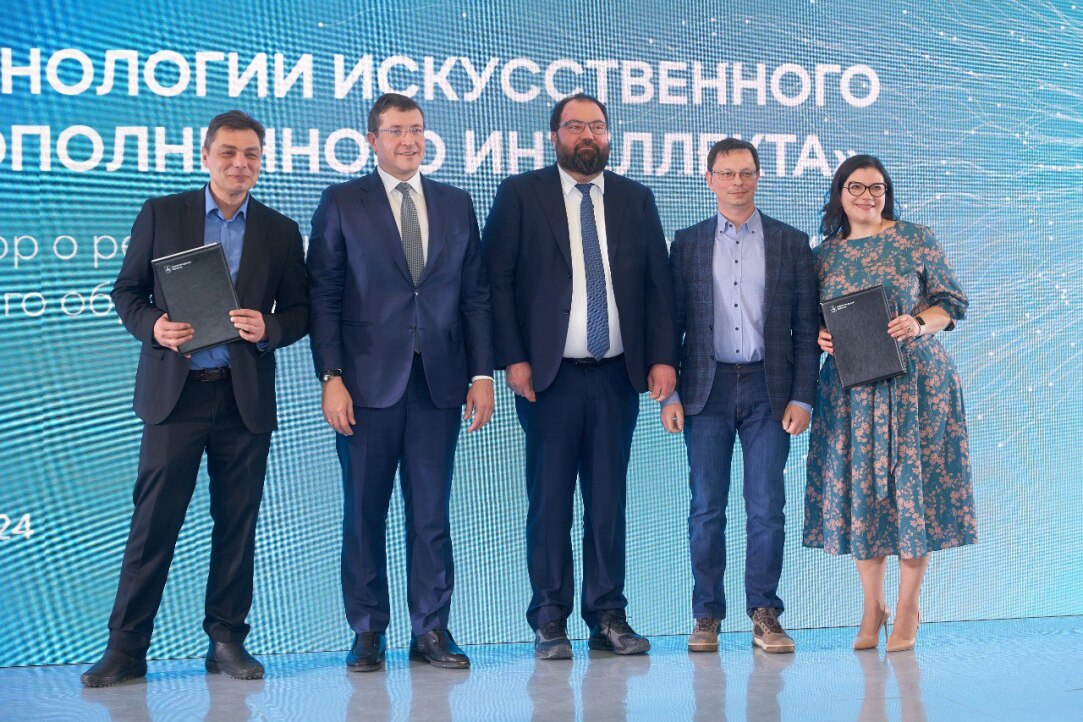
HSE University, together with the world-class Neimark IT campus, is preparing a unique professional environment for future IT specialists: to this end, an IT school will be created in the Nizhny Novgorod region, and on September 1st, the first network degree programme ‘Artificial and Augmented Intelligence Technologies’ will be launched at HSE University in Nizhny Novgorod.
The agreement on implementing the programme was signed in Nizhny Novgorod at a presentation on the complex development of an IT hub in the Nizhny Novgorod region which was delivered to the heads of federal IT corporations with the participation of the Minister of Digital Development, Communications and Mass Media of the Russian Federation Maksut Shadaev, Governor of the Nizhny Novgorod Region Gleb Nikitin and HSE University Rector Nikita Anisimov.
The agreement on the implementation of the first network programme of higher education ‘Artificial and Augmented Intelligence Technologies’ was signed by Anna Blyakhman, Director of HSE University in Nizhny Novgorod, and Valery Cherepennikov, Director of the Project Office of the Neimark IT Campus.
Students on the programme will study methods, models and concepts of artificial intelligence, acquire skills in the practical use of neural networks, image recognition and speech, and learn how to use data analysis and machine learning technologies throught the experiences of leading IT companies.
Gleb Nikitin
‘Artificial intelligence has become one of the key areas of training on the IT campus for a very good reason. Our region has accumulated serious experience in this area. Yuri Neimark stood at the origins of artificial intelligence in Gorky about half a century ago, and the OpenCV computer vision library, which Nizhny Novgorod engineers worked on, became a unique example of such products and features of IT in Nizhny Novgorod,’ says Gleb Nikitin, Governor of the Nizhny Novgorod region.
Admissions to the programme will open this year. Applicants must pass the Unified State Exam in mathematics, computer science and Russian language.
HSE University Rector Nikita Anisimov empahsised that the joint programme with the IT campus is unique in both its content and learning technology.
‘The programme combines the best teachers from HSE with experts from leading companies in the industry, who will jointly help students acquire skills on real projects. As a result, we will have highly qualified graduates with both the modern practical experience and soft skills necessary to solve problems of the future of the digital data economy,’ says HSE Rector.

Valery Cherepennikov
‘The programme is designed to give graduates a strong fundamental mathematical knowledge that provides the basis for intelligent solutions, and multiple practice-oriented courses that form skills in developing and implementing machine learning algorithms, as well as applying neural networks and deep learning to solve real problems. Industrial expertise and in-depth specialisation in these areas will be provided by the Neimark IT Campus. Throughout their study, students will participate in project activities, attend specialised courses from partners, workshops, and take part in special events. Thus, after graduation, we will have exceptional employees in great demand on the market,’ explaines Valery Cherepennikov.


‘For HSE University, the programme ‘Artificial and Augmented Intelligence Technologies’ is a natural step in the ongoing creation of an ecosystem for talented students who are passionate about IT technologies in Nizhny Novgorod. During their studies, students will be able to gain full-fledged developer experience, receive a number of additional certificates confirming their qualifications, and a ready-made portfolio of completed projects,’ adds Anna Blyakhman, Director of the HSE University in Nizhny Novgorod.
The projects for the development of the IT campus education system include creating a new educational space for future IT specialists, organised by the Neimark IT Campus and HSE University.
‘The project is unique not only due to its location within walking distance from the IT campus facilities, but also due to the concept of the educational process. We plan to enrol up to 1,600 school students into full-time studies. About a thousand more children from all over Russia will be able to study here remotely with modules in an offline format. The programme content will also be uniquel. It considers IT as a cross-cutting specialisation for all professional areas: from fintech and biotech to linguistics and urban studies,’ adds Gleb Nikitin.

See also:

The Future of Cardiogenetics Lies in Artificial Intelligence
Researchers from the AI and Digital Science Institute at the HSE Faculty of Computer Science have developed a program capable of analysing regions of the human genome that were previously inaccessible for accurate interpretation in genetic testing. The program adapts large generative AI (GenAI) models for cardiogenetics to predict how specific mutations affect the function of individual genes.
HSE and Yandex Propose Method to Speed Up Neural Networks for Image Generation
A team of scientists at HSE FCS and Yandex Research has proposed a method that reduces computational costs and accelerates text-to-image generation in diffusion models without compromising quality. These models currently set the standard for text-to-image generation, but their use is limited by high computational loads, the company said in a statement.
A Trap for the Advanced Student: How to Break the Habit of Blindly Trusting Neural Networks
Andrei Ternikov, Associate Professor at the St Petersburg School of Economics and Management at HSE University–St Petersburg, has developed a method for conducting online exams that significantly limits students’ ability to use ChatGPT and other AI models to obtain correct answers. Andrei Ternikov spoke to the HSE News Service about his approach—which won the HSE University Autumn Educational Innovation Competition, received an Alfa Future grant, and was presented at an international conference in Japan.
HSE Researchers Train Neural Network to Predict Protein–Protein Interactions More Accurately
Scientists at the AI and Digital Science Institute of the HSE Faculty of Computer Science have developed a model capable of predicting protein–protein interactions with 95% accuracy. GSMFormer-PPI integrates three types of protein data (including information about protein surface properties) to analyse relationships between proteins, rather than simply combining datasets as in previous models. The solution could accelerate the discovery of disease molecular mechanisms, biomarkers, and potential therapeutic targets. The paper has been published in Scientific Reports.
Human Intuition Proves Stronger than Algorithms: Game Theory Tournament Held at HSE University in Perm
Researchers from the International Laboratory of Intangible-driven Economy (Perm) and the HSE Laboratory of Sports Studies, together with mathematician and science populariser Alexey Savvateev, organised a game theory tournament entitled ‘The Election Race.’ Participants competed both against one another and against artificial intelligence. For now, humans have managed to gain the upper hand and propose more effective strategies.
Educational Programmes on Robotics and Neural Network Technologies Launch at HSE University’s Faculty of Computer Science
Every year, in response to IT industry demands, the Higher School of Economics Faculty of Computer Science launches new educational programmes while updating existing ones. In 2026, the faculty introduced Bachelor’s and Master’s degree programmes in robotics for the first time.
‘Policymakers Should Prioritise Investing in AI for Climate Adaptation’
Michael Appiah, from Ghana, is a Postdoctoral Fellow at the International Laboratory of Intangible-Driven Economy (IDLab) at HSE University–Perm. He recently spoke at the seminar ‘Artificial Intelligence, Digitalization, and Climate Vulnerability: Evidence from Heterogeneous Panel Models’ about his research on ‘the interplay between artificial intelligence, digitalisation, and climate vulnerability.’ Michael told the HSE News Service about the academic journey that led him to HSE University, his early impressions of Perm, and how AI can be utilised to combat climate change.
AI Overestimates How Smart People Are, According to HSE Economists
Scientists at HSE University have found that current AI models, including ChatGPT and Claude, tend to overestimate the rationality of their human opponents—whether first-year undergraduate students or experienced scientists—in strategic thinking games, such as the Keynesian beauty contest. While these models attempt to predict human behaviour, they often end up playing 'too smart' and losing because they assume a higher level of logic in people than is actually present. The study has been published in the Journal of Economic Behavior & Organization.
HSE Scientists Develop DeepGQ: AI-based 'Google Maps' for G-Quadruplexes
Researchers at the HSE AI Research Centre have developed an AI model that opens up new possibilities for the diagnosis and treatment of serious diseases, including brain cancer and neurodegenerative disorders. Using artificial intelligence, the team studied G-quadruplexes—structures that play a crucial role in cellular function and in the development of organs and tissues. The findings have been published in Scientific Reports.
HSE Strategic Technological Projects in 2025
In 2025, HSE University continued its participation in the Priority 2030 Strategic Academic Leadership Programme, maintaining a strong focus on technological leadership in line with the programme’s updated framework. A key element of the university’s technological leadership strategy is its Strategic Technological Projects (STPs), aimed at creating in-demand, knowledge-intensive products and services.