

Returning to Moscow for a Double Degree Programme
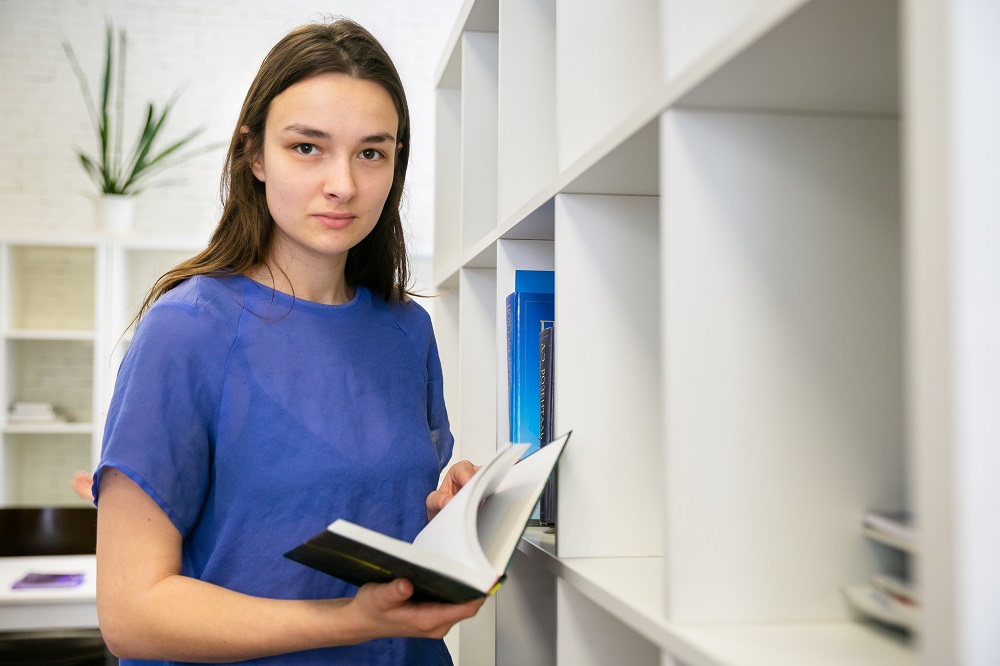
Inspired by her exchange experience in Moscow during her undergraduate studies, French student Marion Jacquart decided to do her Master’s at the School for Advanced Studies in the Social Sciences in Paris because it has a double degree agreement with HSE University. As she finishes her programme in Comparative Social Research in Moscow, where she has been based for the last year doing research for her Master’s thesis on feminism, she shared her experience and impressions with the HSE News Service.
Studying at HSE University
When I did my exchange programme at Moscow State University as an undergraduate, I had some friends from HSE University. While I had heard that it was one of the top universities, I had never visited or attended any conferences here. The place was rather new for me.
As part of the double degree track, I had to earn 60 credits this year, which meant taking a lot of classes. This wasn’t so hard in itself, but with writing the Master's thesis, it was a little challenging. We had a lot of work, so I learned to work quickly. Since my programme is English-taught, I got quite a bit of experience writing in English as well.
I had very interesting courses this year. Perhaps the most new and surprising were the classes in statistics, which we don’t have in France, at least not at my university and not in sociology. Now I really want to learn about it because I think it is very useful, especially because I’ve seen other students presenting research that uses this method. In our Comparative Social Research programme, half of the students are Russian and half are international, so I’ve learned a lot about different approaches to study and research.
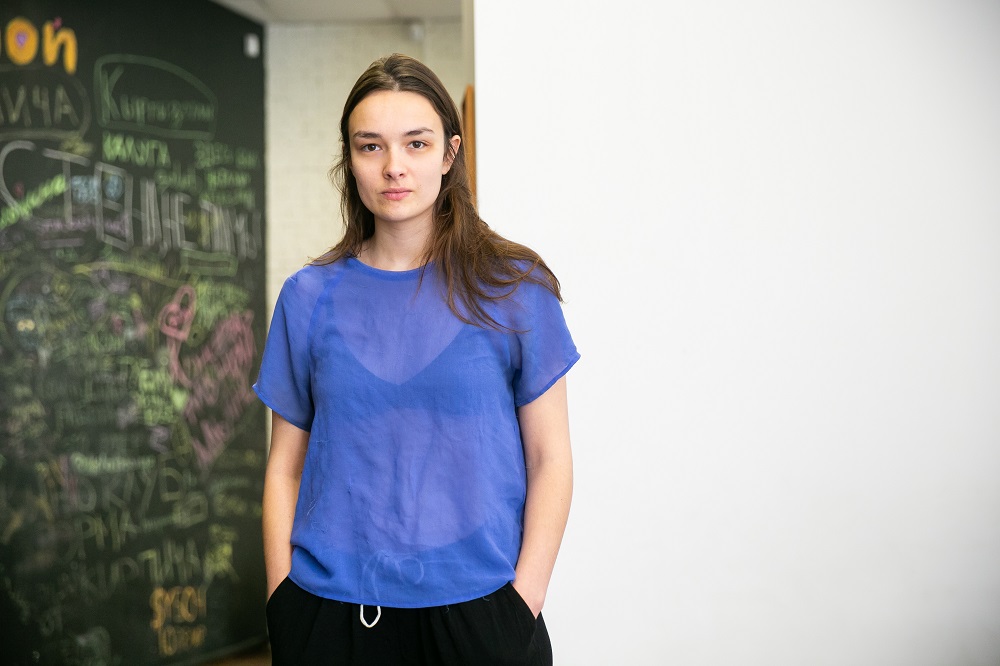 Marion Jacquart
© Mikhail Dmitriev/ HSE University
Research
This year, I had one academic supervisor from HSE University, Christian Fröhlich, and one from France who are advising me on my Master’s thesis, which is on feminism in Russia. I did a case study analysis of a feminist festival, FemFest, that was held two years ago. My research was completely qualitative. I made observations and conducted interviews in both English and Russian. I decided to focus on this festival because it is easier to have one event to investigate and to see what was going on around it, what tensions were being expressed, what friendships formed, and what topics discussed. There was a lot to look at!
There are a lot of feminist groups and organizations in Moscow, for example, crisis centres, and there are quite a few people here who identify themselves as feminists, although not as many as in other countries. I was expecting to see people my age, 20-22, but in fact, there were both older and younger people. That said, I didn't meet people over 40. Feminists here have the same theoretical grounding and ideological commitment as other feminists, for example, in Europe, Latin America, or in Africa.
The main concerns of Russian feminists are more or less universal, although there are some local variations. For example, the issue of domestic violence is very strong here. This issue exists in every country, but here it is more prominent, so feminists try to talk about it. Other concerns include homosexuality, body shaming, slut-shaming, and rape, as in many other countries. I cannot say that there is a particular problem in Russia that doesn’t exist in the rest of the world.
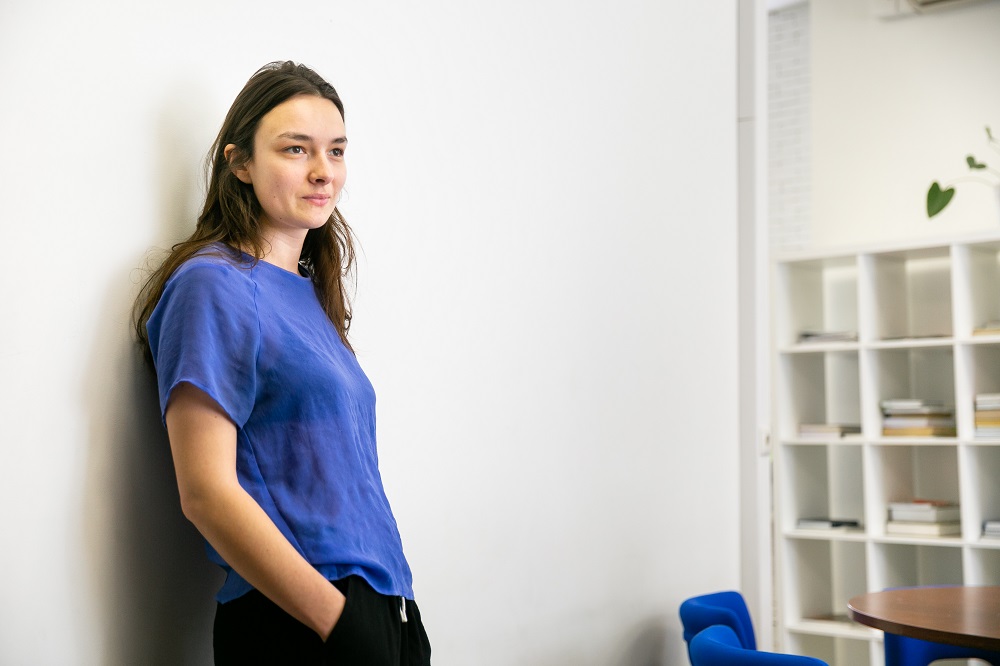 Marion Jacquart
© Mikhail Dmitriev/ HSE University
Living in Russia
When I first came to Moscow, getting around was challenging. I didn't understand anything even though I had studied Russian at school since I was 8 (we had to choose a foreign language and I thought that it would be cooler to study Russian). But this time, it’s better. I am taking acting classes in Russian, and it helps me a lot.
I think it's possible to get around without Russian, but my advice would be to really spend time speaking with Russian people rather than staying with international students. When I came to study at Moscow State University for the first time, the fact that local people were very interested in talking to me was something that surprised me in a positive way. I know that in France, French people don't talk to foreigners, or at least not in French. Here, I met people who only spoke Russian. I could not speak Russian at first, but even still, they would make every effort to make me feel very welcome. I also met people who wanted to practice French or English. People are very welcoming.
.png) Favourite Russian cartoon character: Cheburashka – a little bear with big ears
Favourite Russian cartoon character: Cheburashka – a little bear with big ears.png) Favourite Russian dish: borsch
Favourite Russian dish: borsch.png) Favorite place in Moscow: Chystie Prudi
Favorite place in Moscow: Chystie Prudi.png) Favorite Russian author: Gogol
Favorite Russian author: Gogol.png) Favorite place in HSE buildings: the cinema club located in 2/8 Khitrovsky pereulok, building 5
Favorite place in HSE buildings: the cinema club located in 2/8 Khitrovsky pereulok, building 5
During my first visit as an exchange student, I spent six months here, but I had more cultural shock this time, because the first time I was living with international students. I had some Russian friends then, of course, but I was not fully immersed in the culture. This time, I share an apartment with Russian people. And it's the little things that are not easy at first. I think I was expecting that it would be like living together as friends. In fact, people spent more time in their rooms, which was very unexpected. At first, I thought that it was a problem with me, but then I understood this is more how Russians live together. Russians have a different way of communicating with people. Initial contact can be quite difficult, but then people become warmer. I have some French friends here, and I also have Russian friends who love France and who want to practice French.
Moscow is a big city, so everywhere I want to go, I need an hour to do so, which can be a bit tiring. Otherwise, living in Moscow has been very nice. There is always something to do, which is awesome. I have visited Moscow museums, theatres, and parks. During the first semester, I learned aikido from an American who coaches it at HSE University. I've also been to St. Petersburg four or five times. I would like to go to Kazan, and I would really like to see the countryside, as people say it’s very different from Moscow and that the people are different. I would really like to go to Siberia or Kamchatka.
Admissions to Master’s programme in Comparative Social Research are open. International students can apply online. To learn more about HSE University, its admission process, or life in Moscow, please visit International Admissions website, or contact the Education & Training Advisory Centre at: inter@hse.ru, or via WhatsApp at: +7 (916) 311 8521.
Icons made by srip from www.flaticon.com is licensed by CC 3.0 BY

Christian Fröhlich
Assistant Professor at School of Sociology
See also:

Social Integration: At the Crossroads of Knowledge and Values
The International Laboratory for Social Integration Research (ILSIR) at HSE University studies the challenges faced by vulnerable groups and explores ways to help them participate fully in everyday life. To develop effective solutions, the laboratory’s researchers combine cutting-edge methods with practical fieldwork. In this interview with the HSE News Service, Laboratory Head Elena Iarskaia-Smirnova discusses the laboratory’s work.
Sociologists: Conservative Consumers Dominate Russian Middle Class
The Russian middle class cannot be regarded as a homogeneous and uniformly stable social group. Similar income levels often mask significant differences in financial strategies, lifestyles, and levels of economic security. This is the conclusion reached by sociologists at HSE University. The study has been published in Voprosy Ekonomiki.
The 'Second Shift' Is Not Why Women Avoid News
Women are more likely than men to avoid political and economic news, but the reasons for this behaviour are linked less to structural inequality or family-related stress than to personal attitudes and the emotional perception of news content. This conclusion was reached by HSE researchers after analysing data from a large-scale survey of more than 10,000 residents across 61 regions of Russia. The study findings have been published in Woman in Russian Society.
'When I Do My Work Well, It Benefits People with Mental Disabilities and Their Families'
After exploring several research fields, Maxim Gurin realised that he wanted to study sociology while specifically focusing on how his research could benefit the people at the centre of it. In this interview with the HSE Young Scientists project, he shares his passion for hip-hop dancing, the magical appeal of the courtyard at the House on the Embankment, and his quest to uncover the memories of the Chelyuskinitsy during a trip along the Trans-Siberian Railway.
Researchers Examine Student Care Culture in Small Russian Universities
Researchers from the HSE Institute of Education conducted a sociological study at four small, non-selective universities and revealed, based on 135 interviews, the dual nature of student care at such institutions: a combination of genuine support with continuous supervision, reminiscent of parental care. This study offers the first in-depth look at how formal and informal student care practices are intertwined in the post-Soviet educational context. The study has been published in the British Journal of Sociology of Education.
‘This Programme Helps Me Understand Global Dynamics’
Mahmoud Tarayra, from Jordan, is studying on the HSE University and Kyung Hee University Double Degree Programme in Economics and Politics in Asia. In his interview with the HSE News Service, he talks about his studies in Moscow, the difficulties of adjusting in Korea, and how to enjoy both summer and winter in Russia.
Happiness as an Industry: Why We Want to Be Happy—And What’s Wrong with That
The expansion of ‘happycracy’ into everyday life unfolds against the backdrop of a diktat of positive thinking, mindfulness, and self-improvement. Yet researchers point to the hidden traps in the pursuit of happiness. Why can being happy sometimes be dangerous? Maria Kucheryavaya, sociologist and visiting lecturer at the HSE School of Communication, reflects on this in her column for IQ Media.
‘HSE Offers a Wealth of Opportunities, but It’s up to You to Take Advantage of Them’
Zhou Jinyu is a third-year student of the Bachelor’s programme ‘Data Science and Business Analytics’ at the Faculty of Computer Science at HSE University. She talked to the HSE News Service about studying on the double-degree programme, her career prospects, her attitude to artificial intelligence, and why it’s important to step out of your comfort zone.
‘Asia Is Fascinating, Rich in Culture, and Expanding in Economic and Political Significance’
Anastasia Baschlykoff is a German citizen who recently enrolled at HSE University to pursue her love of Korean studies. As a student of the Double Degree Programme in Economics and Politics in Asia, she is gaining insight into Asian politics, culture, history, and language, and will spend the third year of the programme on an exchange at Kyung Hee University. In her interview with the HSE News Service, Anastasia explains how the programme aligns with her career plans, considers the potential for collaboration with Asian countries, and shares how life in Russia has managed to surprise her.
‘A Sociologist Is a Curious, Searching and Courageous Person’
One of the oldest programmes at HSE University-St Petersburg is the English-taught Bachelor's programme 'Sociology and Social Informatics'. It has existed for more than ten years, and over this time, the programme has helped many students gain interdisciplinary skills and find their own unique career paths. In this article, Academic Supervisor Anna Nemirovskaya explains how the programme has adapted to modern realities, what sociology truly is, and how one can implement a sociological education.