

HSE Takes Part in BRICS Summit
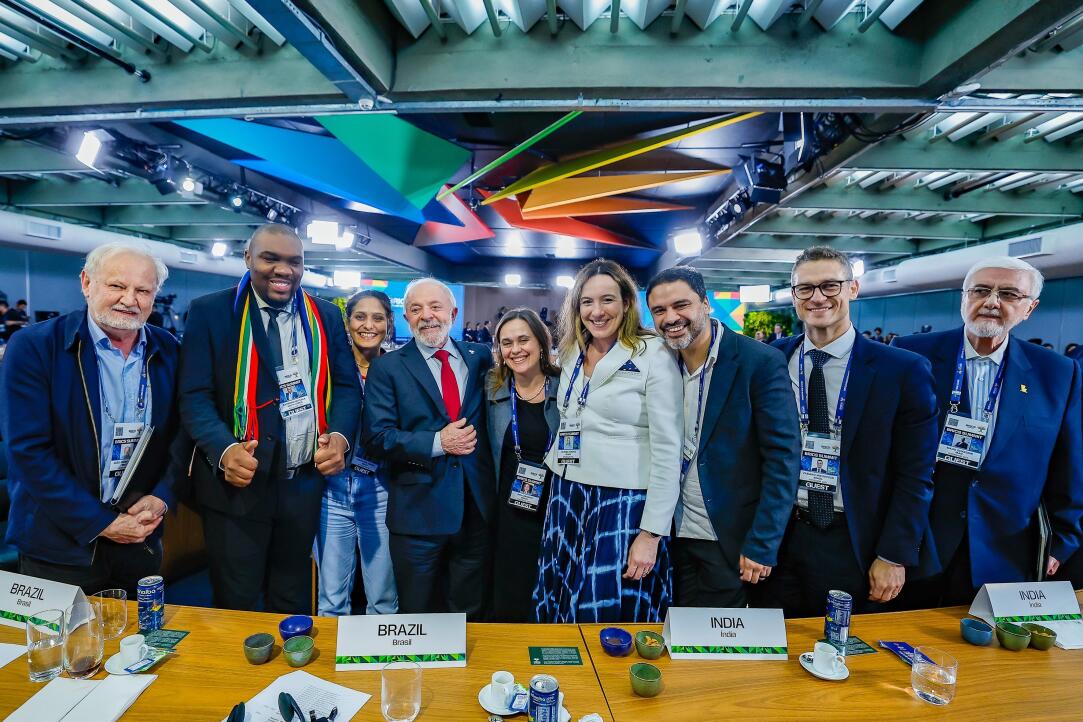
On July 6–7, 2025, the 17th BRICS Summit took place in Rio de Janeiro. For the first time in the organisation’s history, representatives of civil society from BRICS countries participated. HSE Vice Rector, Head of the BRICS Expert Council–Russia, and Co-Chair of the Russian Chapter the BRICS Civil Forum Victoria Panova attended the meeting of the bloc’s national leaders.


In the run-up to the summit, a special session of the Civil BRICS Council was held in Rio de Janeiro on July 4–5. Representatives of civil society from the member countries reached consensus on a set of recommendations, which were formally presented to the heads of state on July 6 during the summit.
The presentation of these recommendations at the highest level marked the culmination of months of work within the BRICS civil track, which brought together over 120 public organisations from BRICS member and partner countries. Since the beginning of the year, dozens of online consultations had been held to develop a coordinated position. In April and May, HSE University hosted roundtable discussions involving the Russian chapter of the Civil BRICS Council, during which thematic working groups drafted position papers. A key milestone in the preparation process was the first on-site session of the Civil BRICS Council, held on July 4–5 in Rio de Janeiro. The special session brought together delegations of civil society activists, experts, and academic representatives from BRICS countries and their partners.
The final document outlined proposals across seven key areas of the Global South’s agenda. The recommendations focus on enhancing cooperation in the social, economic, technological and cultural spheres, expanding academic exchange, strengthening digital sovereignty, promoting sustainable development, and formalising civil society participation within the BRICS framework. Collectively, they reflect a desire for a fairer and more equitable world order in which the interests of developing nations and the voice of civil society play an increasingly prominent role.

Victoria Panova
‘Civil BRICS is not just a movement. It is not merely a club. It is a family. For the first time, we can say that BRICS represents a qualitatively new form of international alliance. Civil BRICS is an important complement to this, as the process clearly demonstrates how close we are and how much we can accomplish together for the benefit of our peoples,’ noted Victoria Panova. She added that the formalisation of the Civil BRICS Council was made possible through the combined efforts of all member states, with crucial institutional steps taken during Russia’s presidency in 2024.
The establishment of the Civil BRICS Council was enshrined in the Kazan Declaration in July 2024. It became a natural continuation of the BRICS Civil Forums held annually since 2015. Over the past decade, this track of public diplomacy has evolved into a permanent platform for dialogue between civil society organisations and BRICS governments.
For several years, HSE University has been providing expert support for civil society engagement within the BRICS framework. The university actively contributes to shaping Russia’s people-to-people agenda and helps to promote the values of equitable dialogue, sustainable development, and inclusive community involvement in international cooperation processes.
The next on-site meeting of the Civil BRICS Council is scheduled for October 2025 in the city of Salvador, Brazil. It will continue the discussion of implementation mechanisms for the proposed initiatives and explore ways to broaden the participation of Global South countries in the bloc’s agenda.

See also:

Physicists Discover What Happens Inside a Stable Vortex
Large vortices with characteristic spiral arms are often observed in the atmosphere and the ocean. Physicists from HSE University have explained how these structures form and why they retain their shape. The researchers found that velocities at points located along the same vortex arc remain correlated even over long distances. At the same time, this correlation weakens rapidly with increasing distance from the vortex centre. These differences help explain the formation of spiral arms and may improve models of atmospheric and oceanic currents. The findings have been published in Physical Review Fluids.
‘The Peak of Stupidity’ and ‘The Valley of Despair’: HSE Economists Propose an Explanation for the Dunning–Kruger Effect
The Dunning–Kruger effect, which describes a sharp surge in self-confidence among beginners followed by an equally rapid decline as they gain experience, can be explained by the nature of the learning process and the acquisition of new knowledge. This conclusion was reached by Andrey Vorchik of the HSE Faculty of Economic Sciences together with independent researcher Murat Mamyshev. They developed a mathematical model of learning and demonstrated how subjective confidence is formed and changes as knowledge accumulates, as well as how teachers can reduce the ‘valley of despair’ experienced by learners.
Advancing Collaboration: HSE Faculty of Computer Science and Harbin Institute of Technology Hold Joint Seminar
From July 13 to 16, 2026, the Faculty of Computer Science hosted the Russian–Sino Research Seminar on Machine Learning Applications, organised by the HSE Laboratory for Cloud and Mobile Technologies in partnership with the Harbin Institute of Technology (China). A delegation comprising seven students and three university representatives travelled to Moscow to take part in an intensive four-day programme.
HSE and Karakalpak State University Agree on Cooperation
HSE University and Berdakh Karakalpak State University have signed a cooperation agreement to strengthen collaboration in research, education, and innovation. Through the expertise of its Сentre of Digital Technologies for Nature-Based Solutions of the Carbon Measurement Supersites Programme, HSE University will work with colleagues from Uzbekistan to assess climate risks and evaluate opportunities for implementing nature-based climate projects in the region. The partners also plan to develop joint research and educational programmes.
‘We Are Always Open to Collaboration, and China Is One of Our Most Important Partners’
From July 20 to 27, 2026, the HSE Faculty of Urban and Regional Development (FURD) is hosting a summer school for students from Tianjin University dedicated to the preservation of cultural heritage. Throughout the week, participants have attended lectures, practical workshops, and field visits to some of Moscow’s most iconic heritage sites. The summer school is the faculty’s first international programme of this kind and forms part of the expanding educational cooperation between Russia and China.
Physicists at HSE University and FIAN Discover Way to 'Photograph' Sound for Testing Materials Used in 6G Communications
Researchers at HSE University, in collaboration with colleagues from the Lebedev Physical Institute of the Russian Academy of Sciences (FIAN), have developed a method for rapidly determining how firmly a film is bonded to a substrate. This is important for the creation of ultrahigh-frequency acoustic filters, which are key components of next-generation 5G and 6G communications. For the first time, researchers have succeeded in measuring the lateral rigidity of the bond between a two-dimensional material film and a substrate in this way. The study results have been published in Applied Physics Letters.
HSE University and Peking University Expand Their Partnership
Peking University President Gao Song paid his first visit to HSE University as part of his first overseas trip since taking office in May 2026. The main purpose of the talks was to consolidate existing areas of cooperation and expand joint projects between HSE University and Peking University within the framework of the Cross Years of Russia–China Cooperation in Education (2026–2027).
Biologists Discover Unique Properties of MiR-93-5p MicroRNA in Prostate Cancer
Researchers at the International Laboratory of Microphysiological Systems of the HSE Faculty of Biology and Biotechnology investigated how different isoforms of the same microRNA influence gene function in prostate adenocarcinoma. The study found that in some cases, microRNAs can reinforce each other’s effects by targeting and suppressing the same genes. This finding offers a fresh perspective on the molecular mechanisms underlying tumour development and on the search for disease biomarkers. The results have been published in PeerJ.
Researchers Discover How Spelling Errors Slow Down Reading in Russian
Psycholinguists from the Centre for Language and Brain at HSE University–St Petersburg have shown that words that are frequently misspelled are processed more slowly by readers, even when presented with the correct spelling. The researchers confirmed this effect for the first time using Russian-language materials and found that response speed is most strongly linked to how confidently individuals can distinguish the correct spelling of a word from an incorrect one. The study has been published in The Mental Lexicon.
HSE Economists Reveal How the Wage Gap Emerges Among Vocational School Graduates
HSE researchers examined the careers of 600,000 graduates of Russian secondary vocational education programmes and found that at the start of their careers, the gender wage gap reaches 23%, doubling after three years. This disparity is largely due to male and female students choosing different occupations when enrolling in vocational schools. These were the findings made by Sergey Roshchin, Natalya Yemelina, and Ksenia Rozhkova from of the HSE Faculty of Economic Sciences. The article has been published in Educational Studies.